Skip to content
I’ve stared at dozens of cracked edge paint samples spread across my inspection table, each one representing a customer complaint and a production batch that didn’t meet expectations. What started as "the paint must be defective" conversations consistently revealed something more complex — handbag edge paint failures emerge from mismatched compatibility between base materials, application environments, and actual usage scenarios, not simply from poor-quality paint.
Edge paint failures in leather goods production stem from three interconnected variables: chemical incompatibility between leather substrate and paint formulation1, environmental conditions during application, and the gap between static testing standards and dynamic real-world usage. Meeting industry specifications doesn’t prevent failure if your acceptance testing doesn’t replicate how customers actually use the bags. Effective prevention requires scenario-based testing that simulates specific stress conditions — flexing frequency, humidity exposure, and contact friction — rather than relying solely on standardized compliance certificates.
Most brands assume edge paint quality control ends with supplier certificates and sample approval. Through years of investigating returned products and comparing process records, I’ve learned that paint failures tell a story about what happened long before the paint touched the leather — and the testing protocols that should have caught the problem never asked the right questions.
Why Does Edge Paint Crack on Handbags?
Every complaint starts the same way: "Your edge paint is cracking after three months." The customer expects me to blame the paint supplier. Instead, I ask to see the failed product alongside the production process records.
Edge paint doesn’t crack because it’s inherently defective — it cracks when the paint chemistry conflicts with residual substances in the leather substrate, when application conditions create weak adhesion layers, or when the cured paint film lacks the flexibility required for repeated mechanical stress. The paint might pass every industry test in controlled conditions yet fail completely in normal daily use.
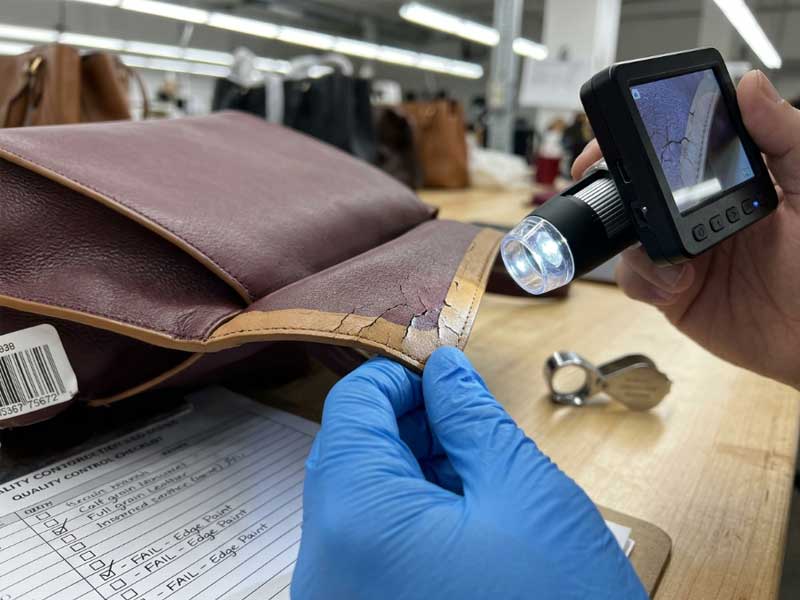
When I disassemble failed products, the crack pattern reveals the real cause. Paint that peels away cleanly, showing unstained leather underneath, indicates poor adhesion — the paint never bonded properly with the base material. Paint that cracks but remains attached, with visible leather fiber damage at the break point, suggests the substrate itself wasn’t stable when the paint was applied. Paint that shows fine spider-web cracking concentrated at flex points signals that the cured film is too rigid for the mechanical demands of that specific bag design.
Chemical Incompatibility Between Leather and Paint
Leather isn’t chemically inert. It contains moisture, natural oils, fat liquors from tanning processes, and finishing chemicals2. Each of these can interfere with how edge paint bonds and cures.
I once traced a batch failure to leather that arrived with higher-than-normal oil content from the tannery’s fat-liquoring process. The oil created an invisible barrier that prevented the water-based edge paint from penetrating the substrate. The paint looked perfect when it dried, passed all visual inspections, and shipped to the customer. Three months later, the paint began separating from the leather along every edge.
The production records showed identical application procedures for both the failed batch and previous successful runs. The only variable was the leather batch. When I compared moisture content testing data, the failed leather showed readings within the tannery’s specification range but at the higher end. We had relied on the supplier’s quality certificate without conducting our own compatibility pre-test between that specific leather batch and our paint system.
Environmental Conditions During Application
Paint application happens in real factory environments, not laboratory clean rooms. Humidity fluctuates. Temperature varies between morning and afternoon shifts. These variations directly affect how edge paint behaves.
Water-based edge paints are particularly sensitive to humidity during application and curing. When workshop humidity rises, the paint takes longer to dry, allowing more time for dust contamination and uneven leveling. More critically, if workers apply the second coat before the first coat has fully cured — rushing to meet production schedules — the moisture trapped between layers creates weak adhesion points that fail months later.
I reviewed process records for two production runs of identical handbags, one batch performing well and another generating complaints. The only documented difference was workshop humidity levels during the week each batch was processed. The failed batch was painted during a period of higher humidity, and workers maintained the same inter-coat timing they used in drier conditions. The paint appeared dry to touch but hadn’t reached full internal cure before the next layer was applied.
The Gap Between Static Standards and Dynamic Usage
"Does your edge paint meet industry standards?" This question appears in every specification discussion. My answer is always the same: Which usage scenario are we designing for?
Industry standards test edge paint under controlled conditions — specific temperature, humidity, and mechanical stress cycles. A paint that passes these tests demonstrates baseline quality. But standards don’t define how intensely customers actually use their handbags.
A structured handbag displayed in a retail environment experiences minimal flex stress. The same handbag used daily for commuting encounters repeated bending at connection points, friction against clothing and other bags, exposure to varying humidity when moving between air-conditioned spaces and outdoor heat, and occasional impacts when dropped or knocked against surfaces.
I’ve seen edge paint that performed perfectly on display samples fail rapidly in field use. The paint wasn’t defective by any measurable standard — it simply wasn’t formulated for the mechanical demands of that specific bag design and usage pattern. The specification discussion focused entirely on visual appearance, color matching, and gloss level. No one asked about flexibility testing under repeated flex cycles or adhesion testing after accelerated humidity exposure.
How Can Manufacturers Prevent Edge Paint Failures?
Prevention starts long before paint touches leather. It requires understanding that edge paint performance depends on system compatibility — matching paint formulation to leather characteristics, controlling application conditions, and testing against realistic usage scenarios.
Effective edge paint failure prevention requires three integrated controls: substrate preparation testing that confirms compatibility between specific leather batches and paint chemistry, documented environmental parameters during application with verified inter-coat cure times, and scenario-based acceptance testing that simulates the mechanical stress and environmental exposure your specific bag design will encounter in actual use. This approach costs less than managing post-production failures but requires moving beyond standard compliance mentality.
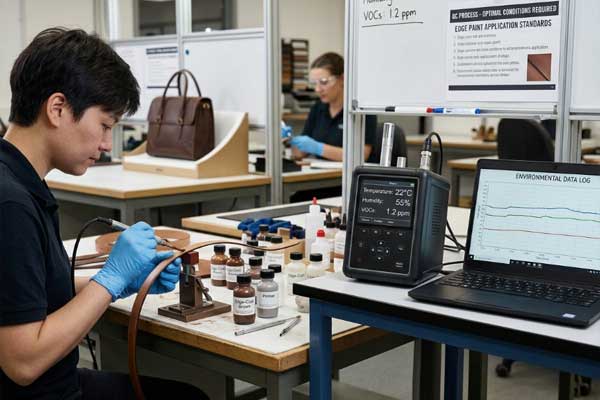
Most manufacturers implement quality control after problems emerge. The more effective approach is designing prevention into the process specification itself.
Pre-Production Compatibility Testing
Every new leather batch should undergo compatibility testing with your edge paint system before production begins. This isn’t about questioning your supplier’s quality certificates — it’s about verifying how that specific leather interacts with your specific paint under your specific conditions.
I maintain a simple pre-production protocol: Take sample pieces from the incoming leather batch, prepare edges using your standard process, apply your production edge paint, cure under your typical conditions, and subject the samples to accelerated testing — repeated flexing, adhesion tape tests, and exposure to elevated temperature and humidity.
This testing takes one to two days and catches most compatibility issues before they become batch-level failures. When testing reveals problems, we can adjust the process — modify leather conditioning procedures, allow longer stabilization time for substrate moisture content, or switch to an alternative paint formulation — before committing thousands of meters of leather to production.
The cost of this pre-testing is minimal compared to reworking finished bags or managing customer returns. More importantly, it generates data that helps refine your process specifications over time. You learn which leather characteristics correlate with edge paint problems, which environmental conditions create risk, and which paint formulations provide more tolerance for process variation.
Controlling Application Environment Parameters
Paint suppliers provide recommended application conditions: temperature ranges, humidity limits, and inter-coat timing. These recommendations come from controlled testing environments. Your factory floor operates under less controlled conditions.
Rather than assuming you can maintain supplier-recommended conditions at all times, implement monitoring systems that document actual environmental parameters during production. Simple temperature and humidity loggers placed in your edge paint workstations create a data record that can be correlated with quality outcomes.
When process records show environmental conditions during production, failure investigation becomes far more effective. You can identify patterns: edge paint applied during specific humidity ranges shows higher failure rates, or certain shifts consistently have better outcomes because workshop temperature naturally stays within optimal ranges.
This data allows you to implement practical controls. If afternoon humidity regularly exceeds optimal ranges, schedule edge paint operations for morning shifts when conditions are more stable. If inter-coat cure time recommendations assume specific temperature ranges, extend cure times when actual temperature is lower. These adjustments cost nothing but require acknowledging that process specifications should adapt to real conditions rather than assuming conditions always match supplier recommendations.
Scenario-Based Acceptance Testing
Standard compliance testing validates baseline quality. Scenario-based testing validates fitness for purpose.
When developing acceptance criteria for a new handbag design, I ask: How will customers actually use this bag? A structured office tote experiences different stress than a slouchy hobo bag that flexes continuously during movement. A handbag with rigid sidewalls protects edge paint from abrasion better than a soft, unstructured design where edges constantly contact other surfaces.
Based on usage patterns, I design simple tests that simulate those stresses. For flexible bags used daily, I implement repeated flex testing — bending the bag edges back and forth several hundred times, far exceeding standard test protocols. For bags that customers might drop or knock against surfaces, I include impact testing at edge points. For products targeting humid climates, I extend humidity exposure testing beyond standard durations.
These tests aren’t laboratory procedures requiring expensive equipment. They’re practical evaluations you can implement in your quality control area. The goal is exposing potential failures during pre-production sampling rather than after full-scale manufacturing.
When scenario testing reveals problems, you have options: reformulate edge paint for greater flexibility, modify the bag structure to reduce edge stress, or adjust customer communication to set realistic durability expectations. All of these options are far less expensive than managing post-sale failures.
What Quality Control Standards Should Buyers Demand?
Brand buyers and importers frequently ask me: "What edge paint standards should I write into my purchase specifications?" This question reveals a fundamental misunderstanding of how quality control works for edge paint systems.
Buyers should specify scenario-based performance requirements rather than generic material standards. Instead of demanding "edge paint must meet ISO specifications," specify "edge paint must survive 1,000 flex cycles without cracking, demonstrate adhesion strength of X under tape test after 72-hour humidity exposure, and maintain color consistency within defined tolerances after UV exposure equivalent to six months typical retail display." These performance specifications force suppliers to test their complete system — leather preparation, paint application, curing process — against realistic usage conditions.
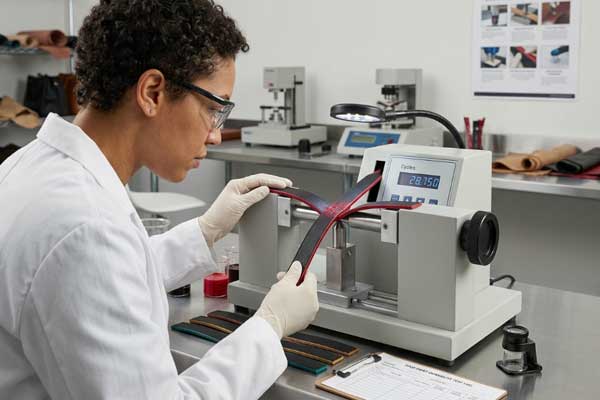
Generic standards provide supplier comfort but limited buyer protection. Performance specifications create accountability for outcomes, not just material compliance.
Material Specifications vs. Performance Requirements
When buyers specify "edge paint must comply with [standard reference]," they’re defining inputs, not outputs. The supplier can provide fully compliant materials that still produce failures because compliance doesn’t guarantee the complete system works under real-world conditions.
Performance requirements shift the conversation. When you specify that edge paint must survive defined flex cycles without cracking, you’re telling the supplier: I don’t care which paint formulation you use or what certificates you hold — demonstrate that the finished product withstands this specific stress.
This approach gives suppliers flexibility to optimize their process while creating clear acceptance criteria. The supplier might achieve performance requirements through superior leather conditioning, modified paint application technique, or enhanced curing procedures — any solution that delivers the specified outcome is acceptable.
I recommend defining performance requirements in three categories:
Mechanical durability — Flex resistance, abrasion resistance, impact resistance
Adhesion strength — Tape test results after environmental exposure
Appearance retention — Color fastness, gloss retention, no cracking or peeling under defined conditions
For each category, specify testing procedures and acceptance criteria that reflect how your specific product design will be used.
Pre-Production Sample Requirements
Purchase specifications should require edge paint testing on pre-production samples made from actual production leather, not generic samples using ideal substrate materials.
Many suppliers submit edge paint samples on standard testing leather that has consistent moisture content, minimal oil content, and uniform surface characteristics. These samples look perfect. When production begins using your actual leather — with normal batch variation in moisture content, fat-liquor levels, and surface finish — the paint behaves differently.
Require that pre-production samples use leather from the same batch designated for your production run. Apply edge paint using the supplier’s production equipment and actual workshop conditions, not in a climate-controlled sample room. Subject these samples to your scenario-based testing protocol.
This approach reveals compatibility issues before committing to full production. It also creates a reference standard — if production quality doesn’t match the approved pre-production samples, you have clear grounds for rejection.
Process Documentation Requirements
Quality control isn’t just about testing finished products — it’s about controlling the process that creates those products.
Specify that suppliers must document critical process parameters during production:
- Incoming leather moisture content readings
- Workshop temperature and humidity during edge paint application
- Inter-coat timing for multi-layer applications
- Cure time before handling or further processing
- Any process deviations from standard procedures
This documentation serves two purposes. First, it ensures suppliers actually monitor conditions that affect quality outcomes. Second, it provides investigation data when problems occur.
When a batch shows edge paint issues, process records allow you to identify what was different about that batch. Without documentation, failure investigation becomes speculation. With documentation, you can pinpoint variables that correlate with quality problems and implement specific corrective actions.
What Are the Industry Standards for Leather Edge Paint?
Industry standards provide a baseline quality framework, but understanding what they actually measure — and what they don’t — is critical for effective quality control.
Common industry standards for leather edge paint include ISO 11644 (testing leather finishes)3, ASTM D3359 (adhesion testing)4, and various flexing, abrasion, and environmental exposure tests. These standards define controlled testing procedures that allow comparison between different materials and suppliers. However, standards measure performance under specific laboratory conditions that may not replicate the complex mechanical stresses, environmental variations, and durability requirements your specific product faces in actual customer use.
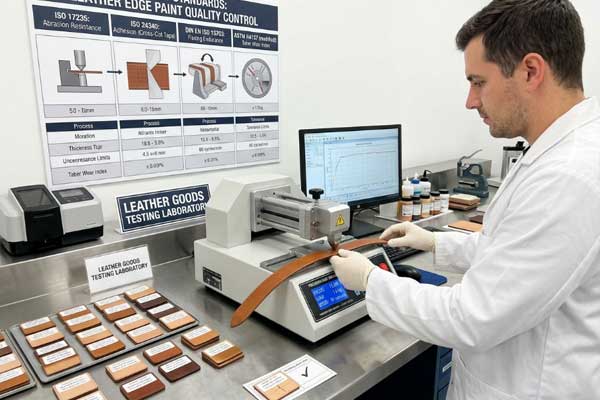
Standards are necessary but insufficient. They provide a common language for quality discussions but don’t replace scenario-based testing that addresses your specific product requirements.
Adhesion Testing Standards
Adhesion tests measure how strongly edge paint bonds to the leather substrate. The most common method uses adhesive tape applied to the painted edge with standardized pressure, then pulled away at a controlled angle and speed.
The test evaluates how much paint removes with the tape. Results are classified on a scale from 0 (no paint removal) to 5 (complete paint removal). Different applications require different adhesion levels — structured handbags with minimal edge flex might accept slightly lower adhesion than soft, frequently flexed designs.
The critical limitation: adhesion testing typically occurs under controlled temperature and humidity conditions on freshly cured samples. Real products experience adhesion challenges after prolonged exposure to varying humidity, temperature cycling, and surface contamination from skin oils and environmental pollutants.
I specify adhesion testing after accelerated environmental exposure — subjecting samples to elevated temperature and humidity cycles before performing tape tests. This approach reveals whether adhesion degrades under conditions that approximate months of actual use.
Flexibility and Flex Resistance Standards
Flexibility testing evaluates whether edge paint can withstand repeated bending without cracking. Standard procedures flex samples over a mandrel of specified diameter for a defined number of cycles, then inspect for cracks or damage.
These tests use controlled conditions: specific flex angle, consistent bending radius, defined cycle frequency. Real handbags experience far more variable stresses — different flex angles depending on how the bag is carried, varying bending radius at different edge locations, irregular cycle frequency depending on user activity.
Standard flex testing provides a baseline comparison between different paint formulations. To validate real-world performance, I increase cycle counts significantly beyond standard requirements and vary flex patterns to include the sharp bends that occur at handle attachment points and structural transitions.
Color Fastness and Light Exposure Standards
Color consistency matters for customer satisfaction and brand reputation. Standard testing exposes edge paint samples to controlled light sources for specified durations, then measures color change using instrumental analysis.
These standards help predict how edge paint color will shift during retail display under store lighting. They’re less effective at predicting color stability under the highly variable conditions customers encounter — direct sunlight exposure when bags are left in cars, storage in dark closets between uses, and contact with various substances.
For products targeting markets with intense sun exposure, I extend light fastness testing beyond standard durations. For products used in humid climates, I combine light exposure with humidity testing to evaluate how these factors interact.
Environmental Resistance Standards
Standard environmental testing exposes samples to defined temperature and humidity conditions for specified periods. Results indicate whether paint shows blistering, cracking, discoloration, or adhesion loss under accelerated aging conditions5.
The challenge with environmental standards is choosing appropriate test parameters. A test simulating moderate temperature and humidity might pass edge paint that fails in high-humidity tropical markets or dry, high-temperature desert environments.
Environmental testing specifications should align with your target market conditions. Products for tropical regions require more aggressive humidity testing. Products for regions with significant temperature variation need thermal cycling tests that simulate daily temperature swings.
How Do Manufacturing Processes Affect Edge Paint Quality?
Edge paint quality depends as much on application process as paint formulation. Two manufacturers using identical paint can produce dramatically different outcomes based on how they prepare leather edges and apply paint.
**Manufacturing process variables that significantly affect edge paint quality include edge surface preparation (sanding consistency and cleanliness), substrate conditioning (moisture stabilization and temperature), paint application technique (layer thickness and uniformity), inter-coat cure times (ensuring complete drying between layers), and final curing conditions6 (temperature, humidity, and duration). Process consistency matters more than material quality for preventing edge paint failures — the best paint applied incorrectly fails while moderate-quality paint applied with controlled process succeeds
-
"Phytic Acid-Containing Reactive Acrylic Emulsions in Leather … – PMC", https://pmc.ncbi.nlm.nih.gov/articles/PMC12610188/. Materials science research on leather finishing demonstrates that residual tanning chemicals, natural oils, and moisture content in leather substrates can interfere with paint adhesion through chemical incompatibility mechanisms. Evidence role: mechanism; source type: research. Supports: the chemical mechanisms by which leather substrate composition affects paint adhesion. Scope note: Research typically examines controlled laboratory conditions rather than the full range of commercial leather processing variations ↩
-
"Tanning (leather)", https://en.wikipedia.org/wiki/Tanning_(leather). Leather science literature describes tanned leather as a complex material containing residual moisture, natural lipids, fat liquors applied during processing, and various finishing chemicals that affect surface properties. Evidence role: general_support; source type: education. Supports: the chemical composition of tanned leather and substances introduced during processing. ↩
-
"ISO 11644:2022 – Leather — Test for adhesion of finish", https://www.iso.org/standard/81924.html. ISO 11644 provides standardized methods for evaluating the performance characteristics of leather finishes under controlled laboratory conditions. Evidence role: definition; source type: institution. Supports: the scope and purpose of ISO 11644 as it relates to leather testing. ↩
-
"Standard Test Methods for Rating Adhesion by Tape Test", https://www.astm.org/d3359-23.html. ASTM D3359 establishes standardized tape test methods for determining the adhesion of coatings to substrates, using a classification scale from 0 to 5 based on the degree of coating removal. Evidence role: definition; source type: institution. Supports: the methodology and purpose of ASTM D3359 for measuring coating adhesion. ↩
-
"Can Accelerated Aging Procedures Predict the Long Term Behavior of …", https://pmc.ncbi.nlm.nih.gov/articles/PMC8398581/. Accelerated environmental testing standards subject coatings to controlled temperature and humidity cycles to simulate extended service exposure, evaluating degradation through visual inspection and performance testing. Evidence role: definition; source type: institution. Supports: the methodology of accelerated environmental testing for evaluating coating durability. ↩
-
"Influence of Process Parameters on Tablet Bed … – PMC", https://pmc.ncbi.nlm.nih.gov/articles/PMC3969493/. Coating science research demonstrates that surface preparation, substrate condition, application technique, and curing parameters significantly influence coating adhesion, uniformity, and long-term performance. Evidence role: general_support; source type: research. Supports: the relationship between coating application process parameters and final coating performance. Scope note: General coating research may not specifically address leather edge paint applications ↩