Skip to content
You’re launching a new handbag line for the European and US markets. Your supplier sends you a REACH test report, and you assume you’re covered for compliance everywhere. Then your US customs broker flags a California Prop 65 issue, and your EU importer asks for supplier registration documents you never knew existed. Suddenly, "eco-friendly manufacturing" isn’t just about choosing greener materials—it’s about navigating completely different regulatory frameworks, minimum order quantities that don’t match your budget, and material performance trade-offs that your retail customers will notice immediately.
Sustainable handbag manufacturing requires balancing three interconnected constraints: market-specific compliance requirements, production scale economics, and material performance limitations. Before selecting eco-friendly leathers or recycled linings, you must first identify your target market’s exact regulatory framework—because REACH certification for the EU and California Prop 65 compliance for the US operate under fundamentally different legal structures1. Success depends on choosing the right testing protocols and supplier qualifications that match both your sales channels and your realistic order volumes.
I’ve spent years as a procurement manager working directly with certified suppliers, processing eco-material orders for European brands and US e-commerce sellers. The most common mistake I see? Clients treating sustainability compliance like a checklist item instead of understanding it as an interconnected system where one wrong assumption about testing scope can delay your entire product launch. Let me walk you through how sustainable handbag manufacturing actually works when compliance deadlines and production realities collide.
What Makes Handbag Manufacturing Truly Sustainable Beyond Material Selection?
Most brand owners think sustainable manufacturing means picking recycled polyester linings and calling it done. That’s not how compliance-ready production actually works.
Sustainable handbag manufacturing extends beyond material sourcing to encompass verifiable compliance documentation, transparent supply chain traceability, and production processes that meet specific regional chemical restriction standards. True sustainability requires your manufacturer to provide batch-traceable test reports, maintain relationships with certified material suppliers who meet minimum order thresholds, and understand the documentation difference between SVHC substance testing and formal supplier registration obligations under REACH.

The reality I encounter constantly: A client asks for "eco-friendly handbags," and I have to clarify whether they mean materials that pass REACH SVHC testing, products that qualify for California Prop 65 exemptions, bags made from verified recycled content, or all three simultaneously. These are separate requirements with different cost structures.
The Three-Way Trade-Off Nobody Warns You About
Every sustainable handbag project forces you to balance:
- Compliance depth – How many markets do you need to clear legally?
- Order scale – Can you meet certified suppliers’ minimum quantities?
- Material performance – Will your customers accept the durability compromises?
In my experience coordinating orders for European fashion brands, the clients who succeed are those who define their primary sales market first, then work backward to material specifications. The ones who struggle try to create a "universal eco-bag" that checks every possible certification box—and end up with 2,000-piece minimum orders they can’t finance and materials that don’t match their brand positioning.
Certified eco-material suppliers typically require 500-1,000 meter minimums2 for water-based PU leathers. Lead times run 2-4 weeks longer than conventional materials because certified dyeing facilities operate on consolidated production schedules. If you’re a startup testing market demand with 200-unit trial orders, you’ll need to choose between compromising on compliance depth or accepting material limitations from suppliers who work with smaller batches.
What Sustainability Actually Costs at Scale
I’ve processed material sourcing for orders ranging from 500 units to 50,000 units. The per-unit compliance cost drops dramatically at volume:
| Order Quantity | Material Premium Over Standard | Testing Cost Per Unit | Lead Time Extension |
|---|---|---|---|
| 200-500 units | 25-40% | $2.50-$4.00 | +3-5 weeks |
| 1,000-2,000 units | 15-25% | $0.80-$1.50 | +2-3 weeks |
| 5,000+ units | 8-15% | $0.30-$0.60 | +1-2 weeks |
These numbers reflect real supplier quotes from our certified material vendors. The testing cost per unit assumes you’re amortizing third-party lab fees across your production batch—not paying for individual bag testing.
The uncomfortable truth: Small-batch sustainable production is disproportionately expensive. If you’re ordering 300 handbags to test Amazon demand, the compliance and material premiums can push your landed cost 35-50% higher than conventional manufacturing. You’ll need retail pricing power or margin flexibility to absorb that difference.
REACH vs. California Prop 65: Why One Compliance Certificate Doesn’t Cover Both Markets?
This is where I see the most expensive mistakes. A client receives a REACH SVHC test report from their supplier and assumes they’re cleared for all US and EU sales. Then they hit customs issues or retailer compliance audits.
REACH (EU) and California Prop 65 (US) are structurally different regulatory systems that require separate compliance approaches. REACH focuses on restricting Substances of Very High Concern (SVHC) through mandatory testing and potential supplier registration, while Prop 65 requires warning labels or certification that products contain no listed chemicals above safe harbor levels. A REACH test report covering 233+ SVHC substances does not automatically satisfy California Prop 65 obligations, because the two systems regulate different chemical lists under different legal frameworks.
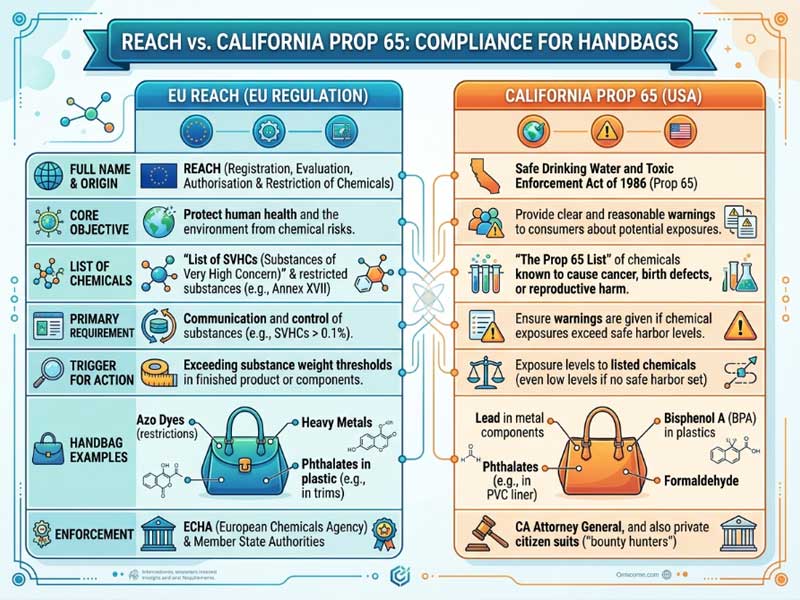
I constantly field questions like "Can’t we just use our REACH report for the US market?" The answer is no—but the reason matters for choosing the right testing strategy.
How REACH Actually Works (Beyond the Test Report)
REACH compliance involves two separate obligations that clients frequently confuse:
1. SVHC Testing (What Most People Think REACH Means)
Your material supplier or finished product undergoes laboratory testing to verify it doesn’t contain Substances of Very High Concern above 0.1% concentration limits. This generates the test report most buyers request.
Current SVHC list (as of 2024): 233 restricted substances3, including heavy metals (lead, cadmium), phthalates (used in PU softening), and certain dyes.
Test coverage you need for handbags:
- Full materials testing (leather/PU, linings, hardware, adhesives)
- Individual component testing if you use multi-supplier parts
- Batch verification if your supplier changes dye lots or hardware vendors
Testing cycle: 7-10 business days for standard SVHC panel
Cost range: $150-$400 per material type (leather, lining, hardware tested separately)
2. Supplier Registration Obligation (What Importers Actually Require)
If your manufacturer or material supplier produces more than 1 ton annually of any substance subject to REACH, they may need to register with the European Chemicals Agency (ECHA). Many EU importers require proof of this registration—not just test reports.
This is where I’ve seen orders delayed. A client has clean SVHC test reports but their EU distribution partner asks for supplier registration documentation, which the manufacturer never completed because they primarily serve Asian markets.
California Prop 65: A Warning Label System, Not a Ban
Prop 65 operates completely differently. It doesn’t ban substances outright—it requires businesses to warn California consumers about potential exposure to chemicals known to cause cancer or reproductive harm4.
Your compliance options:
Option A: Warning Labels
Include a clear and reasonable warning on your product or packaging. This is the cheapest route but carries brand perception risks—customers see "WARNING: This product contains chemicals known to the State of California to cause cancer" and question your sustainability claims.
Option B: Safe Harbor Certification
Test your product and certify that any listed chemicals fall below Prop 65’s "safe harbor" threshold levels. This requires lab testing but allows you to market without warning labels.
Prop 65 chemicals relevant to handbags:
- Lead in hardware and dyes
- Phthalates in PU coatings
- Formaldehyde in adhesives and finishing
- Di(2-ethylhexyl) phthalate (DEHP) in synthetic leathers
Testing cycle: 5-7 business days for Prop 65 screening
Cost range: $200-$500 per product
The Documentation Matrix You Actually Need
Here’s what I tell clients who are selling in both markets:
| Sales Channel | Required Documentation | Supplier Qualification |
|---|---|---|
| EU retail/e-commerce | SVHC test report + potential supplier registration proof | Material supplier with ECHA registration for high-volume substances |
| US retail (excluding CA) | Generally no mandatory testing* | Standard supplier qualification |
| California retail | Prop 65 test report OR warning label compliance | Supplier familiar with Prop 65 chemical list |
| Amazon US | Prop 65 compliance verification | Supplier who can provide batch-specific test reports |
| Amazon EU | REACH SVHC declaration | Supplier with traceable material sourcing |
*Some US retailers impose private compliance standards exceeding legal minimums
The costly mistake: Assuming one supplier with one test report covers all channels. In practice, you need suppliers who understand both systems and can provide the specific documentation your sales channels require.
What Are the Real Performance Trade-Offs with Eco-Friendly Leathers and Recycled Linings?
Every procurement call about sustainable materials eventually reaches the same point: "Will customers notice the difference in quality?"
Eco-friendly alternatives to traditional leather and virgin polyester involve measurable performance compromises in abrasion resistance, tactile consistency, and batch-to-batch color stability. Water-based PU leathers typically show 15-25% lower abrasion cycle ratings than solvent-based versions5, recycled polyester linings may exhibit slight color variation between production runs, and vegetable-tanned leathers require longer break-in periods and more careful maintenance instructions. These aren’t defects—they’re inherent material characteristics that must align with your brand positioning and customer expectations.
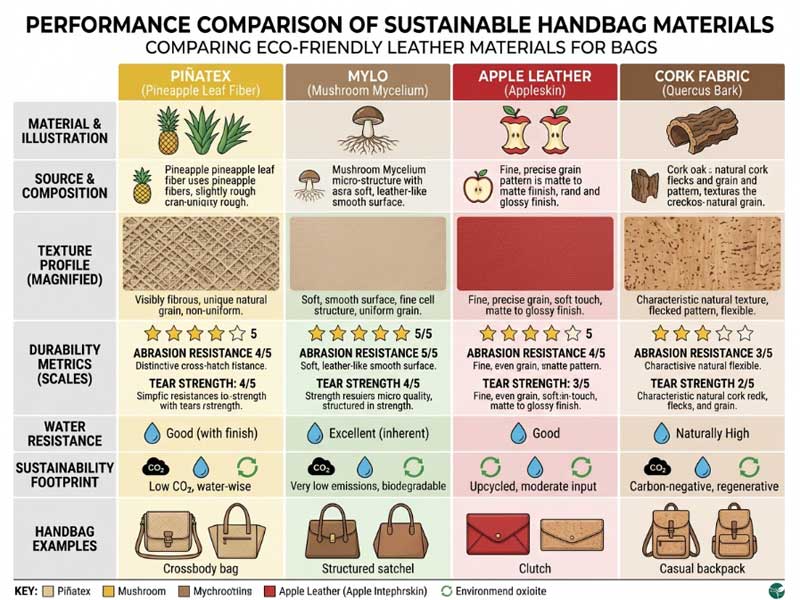
I’ve coordinated sample testing for brands transitioning from conventional to eco-materials. The successful transitions happen when the brand owner understands exactly which performance attributes their customers prioritize—and which compromises their market segment will accept.
Water-Based PU: The Most Common Sustainable Alternative
What it is: Polyurethane leather where the coating uses water as the primary solvent instead of DMF (dimethylformamide) or other volatile organic compounds.
Performance reality:
Abrasion resistance: 20,000-25,000 cycles (Martindale test) vs. 30,000-40,000 for solvent-based PU6
Hand feel: Slightly firmer, less supple than conventional PU—though newer formulations are improving
Color fastness: Comparable to standard PU when properly processed
Weather resistance: Good water repellency, similar to conventional versions
Cost premium: 15-25% over standard PU
Minimum order: 500-800 meters from certified suppliers
Lead time: +2-3 weeks vs. stock PU materials
From my supplier relationships, the biggest limitation isn’t durability—it’s texture consistency. Water-based PU formulations are more sensitive to production temperature and humidity variations. If you’re doing large repeat orders, you need suppliers with climate-controlled coating facilities to maintain batch consistency.
When water-based PU makes sense:
- Fashion handbags with 1-2 year expected lifecycle
- Brands targeting eco-conscious segments who understand the context
- Products where slightly firmer hand feel aligns with structured designs
When to reconsider:
- Heavy-duty travel bags requiring maximum abrasion resistance
- Ultra-premium luxury positioning where tactile perfection is non-negotiable
- Very small trial orders under 300 units where material minimums become prohibitive
Recycled Polyester Linings: The Hidden Compliance Challenge
What it is: Polyester fabric manufactured from post-consumer plastic bottles (rPET) or post-industrial textile waste.
Performance reality:
Tensile strength: Comparable to virgin polyester when using quality rPET
Color consistency: More variable—recycled content affects dye uptake
Texture: Can feel slightly coarser depending on recycled fiber source
Pilling resistance: Equivalent to virgin polyester at similar denier weights
Cost premium: 10-20% over virgin polyester lining
Minimum order: 1,000-2,000 meters for custom colors
Lead time: +1-2 weeks vs. stock linings
The compliance issue I encounter frequently: Many recycled polyester suppliers provide GRS (Global Recycled Standard) certification7, but clients don’t realize GRS covers recycled content verification—not chemical safety testing. You still need separate REACH/Prop 65 testing for the finished fabric, because recycled materials can introduce contaminants from their source stream8.
I’ve seen batches of rPET lining fail Prop 65 testing for residual antimony (a catalyst used in polyester production that concentrates during recycling)9. The material met GRS standards but didn’t meet California’s safe harbor limits. The client had to scrap 800 meters of custom-dyed lining.
Best practice: Request both GRS certification AND chemical safety test reports for recycled linings. Don’t assume "recycled" automatically means "compliant."
Vegetable-Tanned Leather: Premium Positioning with Maintenance Requirements
What it is: Leather tanned using tannins from plant materials (tree bark, leaves) instead of chromium salts.
Performance reality:
Durability: Excellent—often outlasts chrome-tanned leather with proper care
Color development: Patinas and darkens over time (desirable for heritage brands, problematic for color-critical applications)
Water resistance: Lower than chrome-tanned—requires conditioning and weatherproofing treatments
Stiffness: Initially rigid, requires break-in period
Cost premium: 30-60% over chrome-tanned leather
Minimum order: Typically whole hides (15-25 sq ft), harder to source in exact quantities
Lead time: +3-4 weeks—fewer tanneries, longer processing time
From handling orders for heritage leather goods brands, vegetable-tanned leather succeeds when the brand narrative supports the maintenance requirements. Your customers need to understand they’re buying a product that changes character over time—not a flaw, but a feature.
Critical consideration: Vegetable-tanned leather thickness variation within single hides is higher than chrome-tanned. Your bag design must accommodate 0.3-0.5mm thickness differences, or your cutting yield drops significantly.
Material Performance Comparison Table
| Material Type | Abrasion Cycles | Color Stability | Hand Feel | Cost Premium | Compliance Testing |
|---|---|---|---|---|---|
| Solvent-based PU (baseline) | 30,000-40,000 | Excellent | Very supple | Baseline | Standard REACH/Prop 65 |
| Water-based PU | 20,000-25,000 | Good | Slightly firm | +15-25% | Same testing required |
| Recycled PET lining | Equal to virgin | Moderate | Slightly coarse | +10-20% | Enhanced testing recommended |
| Chrome-tanned leather | 50,000+ | Excellent | Supple | Baseline | Metal content testing critical |
| Veg-tanned leather | 50,000+ | Develops patina | Initially stiff | +30-60% | Fewer chemical concerns |
These numbers reflect real-world testing from suppliers we’ve qualified. Your specific results will vary based on supplier process control and material grade selection.
-
"Registration, Evaluation, Authorisation and Restriction of …", https://en.wikipedia.org/wiki/Registration,_Evaluation,_Authorisation_and_Restriction_of_Chemicals. REACH operates as a registration and restriction system through ECHA requiring proactive substance evaluation, while California Prop 65 functions as a warning-based disclosure system focusing on consumer notification rather than substance bans. Evidence role: general_support; source type: government. Supports: The distinct legal frameworks of REACH and Prop 65 regulations. Scope note: This source describes the regulatory structures but does not specifically address handbag manufacturing compliance requirements. ↩
-
"Sustainable Fashion and Apparel Design: Standards | Certificates | Seals", https://guides.library.cornell.edu/c.php?g=662121&p=5277662. Sustainable and certified material suppliers often maintain higher minimum order quantities than conventional suppliers due to specialized production runs, consolidated manufacturing schedules, and the economics of maintaining certification compliance across smaller batch sizes. Evidence role: general_support; source type: other. Supports: Minimum order quantity patterns in sustainable textile supply chains. Scope note: General industry practice rather than specific quantified MOQ data for the 500-1,000 meter range cited. ↩
-
"Substance of very high concern", https://en.wikipedia.org/wiki/Substance_of_very_high_concern. The ECHA Candidate List of Substances of Very High Concern is regularly updated, with the total number of listed substances subject to change as new substances are evaluated and added through the regulatory process. Evidence role: statistic; source type: government. Supports: The current number of substances on the SVHC candidate list. Scope note: The exact count of 233 substances reflects a specific date and may have changed since publication. ↩
-
"About Proposition 65 – OEHHA – CA.gov", https://oehha.ca.gov/proposition-65/about-proposition-65. California’s Proposition 65, formally the Safe Drinking Water and Toxic Enforcement Act of 1986, requires businesses to provide clear and reasonable warnings before knowingly exposing individuals to listed chemicals, rather than prohibiting the substances themselves. Evidence role: mechanism; source type: government. Supports: The warning-based regulatory approach of California Prop 65. ↩
-
"Development of Breathable Waterproof Polyurethane-Coated …", https://pmc.ncbi.nlm.nih.gov/articles/PMC12509000/. Water-based PU formulations generally exhibit reduced abrasion resistance compared to solvent-based alternatives due to differences in polymer cross-linking density and film formation mechanisms, though specific performance varies by formulation and processing conditions. Evidence role: general_support; source type: research. Supports: Performance differences between water-based and solvent-based polyurethane coatings. Scope note: General material science principles rather than specific testing data for handbag applications at the claimed 15-25% differential. ↩
-
"Case Study Of Durability, Abrasion Resistance, And … – ISU ReD", https://ir.library.illinoisstate.edu/urs2021fcs/2/. Martindale abrasion testing measures textile durability through cycle counts, with acceptable commercial performance for apparel and accessories typically ranging from 15,000 to 40,000 cycles depending on intended use and material grade. Evidence role: statistic; source type: research. Supports: Typical Martindale abrasion test results for polyurethane leather materials. Scope note: General testing standards rather than specific comparative data for water-based versus solvent-based PU formulations. ↩
-
"What is the Global Recycled Standard (GRS)?", https://textileexchange.org/faq/what-is-the-global-recycled-standard-grs/. The Global Recycled Standard, administered by Textile Exchange, establishes requirements for third-party certification of recycled content and chain of custody, covering processing, manufacturing, and labeling of products containing recycled materials. Evidence role: definition; source type: institution. Supports: The purpose and scope of GRS certification. Scope note: Describes certification scope but does not address the distinction between recycled content verification and chemical safety testing mentioned in the article. ↩
-
"Post-Consumer Recycled PET: A Comprehensive Review of …", https://pmc.ncbi.nlm.nih.gov/articles/PMC11902774/. Mechanical recycling processes can concentrate trace contaminants present in post-consumer materials, as substances from the original product applications, including additives, dyes, and environmental contaminants, may persist through standard cleaning and reprocessing steps. Evidence role: mechanism; source type: research. Supports: Contamination risks in recycled material feedstocks. ↩
-
"Antimony in Polyethylene Terephthalate-Bottled Beverages", https://pmc.ncbi.nlm.nih.gov/articles/PMC10609323/. Antimony trioxide serves as the primary catalyst in commercial polyethylene terephthalate (PET) polymerization, with trace amounts remaining in finished polymer that may become concentrated when recycled materials are reprocessed multiple times. Evidence role: mechanism; source type: research. Supports: Antimony’s role as a polyester catalyst and behavior in recycling. ↩