Skip to content
When I first started auditing backpack production lines for international brands, I quickly learned that the gap between a factory’s photo samples and their actual bulk production capability was often the difference between a successful launch and thousands of returned units. Most sourcing teams focus on visible design elements—zipper hardware, exterior fabric texture, and stitching color—while the three critical structural systems that determine whether a backpack survives real-world use remain completely invisible until after the deposit clears.
Ergonomic backpack construction is verified through specific, auditable production checkpoints that reveal whether a factory truly controls load distribution physics, stitch reinforcement hierarchy, and complete waterproofing systems. The factories with legitimate capability maintain load-testing equipment (or verifiable third-party test records), use fixed molds for anatomically contoured components, and can demonstrate consistent replication of 3D shaping across production batches—not just hand-adjusted prototypes. Verification happens on the factory floor through equipment inspection, process observation, and sample-to-specification cross-checking, not through marketing claims or catalog photos.
Most buyers discover their factory’s true capability only after bulk production begins, when they realize the prototype they approved was hand-assembled by the factory’s most skilled technician using premium materials, while the production run uses standard operators, downgraded components, and simplified assembly shortcuts. Let me walk you through exactly how to verify these three structural systems before you commit to large-volume orders.
How Do Factories Engineer Proper Load Distribution in Backpack Construction?
Every sourcing manager has seen factory catalogs featuring backpacks with "ergonomic shoulder straps" and "weight distribution systems," but these claims become meaningless when you’re comparing quotes that vary by 40% for seemingly identical products. The real question isn’t whether a factory claims ergonomic design—it’s whether they possess the tooling, process control, and quality verification systems to replicate load distribution engineering consistently across thousands of units.
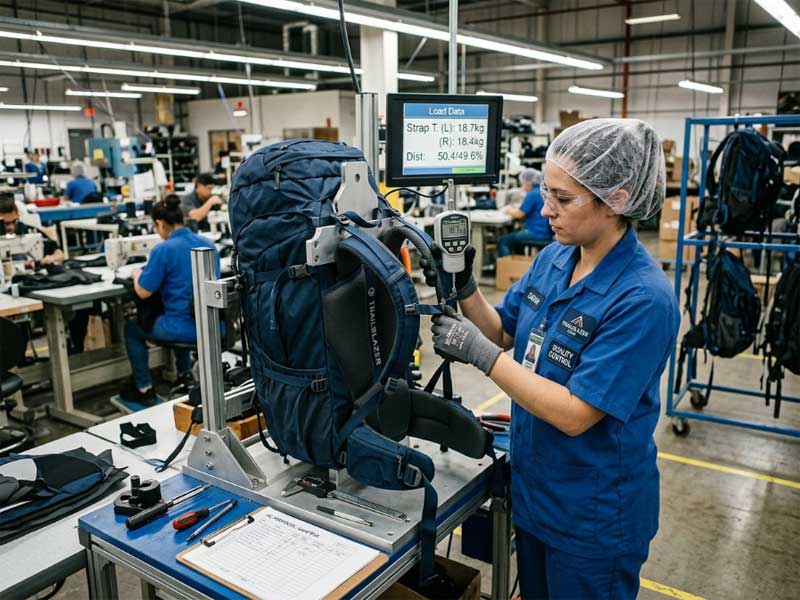
Load distribution quality is determined by three verifiable checkpoints: the structural anchoring system (where shoulder straps and hip belts connect to the bag body), the foam density and contouring in contact zones, and the frame or panel system that transfers weight from straps to the wearer’s skeleton. Factories with legitimate capability can show you the fixed molds they use for curved back panels, demonstrate their stitching reinforcement patterns at stress points, and provide load-test records (either in-house or from qualified third-party labs) that prove their designs perform under specified weight loads.
The Three Hidden Zones Where Load Distribution Fails
In my experience auditing production lines, load distribution problems almost always originate in three specific manufacturing zones that never appear in product photos:
1. Shoulder Strap Anchor Point Construction
The junction where shoulder straps connect to the bag body determines whether a 15kg load feels secure or creates painful pressure points after 30 minutes of wear. I’ve seen factories quote identical specifications but use completely different reinforcement structures:
-
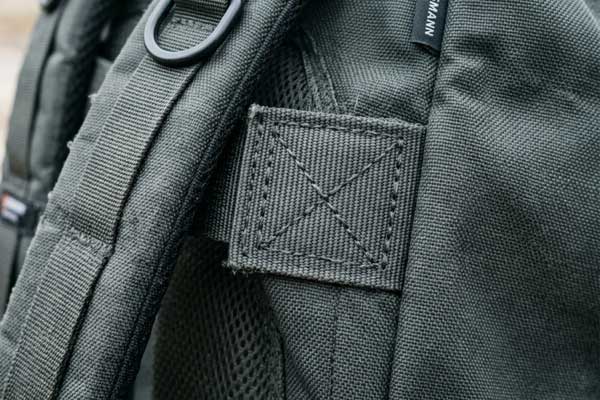
High-capability factories use box-and-X stitching patterns (minimum 10mm × 10mm box with diagonal cross-stitching) at anchor points, with bartack reinforcement at stress corners. The stitching penetrates through three layers minimum: exterior fabric, internal reinforcement webbing (usually 38mm nylon webbing rated for 200kg+ tensile strength1), and interior lining.
-
Cost-cutting factories substitute standard lockstitching without bartacks, reduce reinforcement webbing to single-layer construction, or—most dangerously—stitch only through exterior fabric and interior lining, omitting the load-bearing webbing layer entirely.
Verification method: During factory audit or sample inspection, examine the interior of the bag at shoulder strap anchor points. You should see visible reinforcement webbing (usually a contrasting color) that extends at least 50mm beyond the stitching box. Request a cross-section sample (factories cut these from production rejects) to verify all three layers are penetrated by stitching. If the factory refuses or claims they "don’t keep reject samples," that’s an immediate red flag.
2. Foam Density and Pre-Forming Quality
Shoulder strap and back panel padding determines contact pressure distribution. The critical specification isn’t foam thickness (commonly listed as "10mm EVA foam")—it’s foam density measured in kg/m³ and whether the factory uses pre-formed anatomical shaping versus flat-cut assembly.
When I compare samples from different factories, the distinction becomes obvious:
| Specification Area | High-Capability Process | Cost-Reduction Shortcut | Buyer Impact |
|---|---|---|---|
| Foam density | 40–60 kg/m³ closed-cell EVA or memory foam2 | 20–30 kg/m³ open-cell foam (compresses permanently) | Padding flattens after 2–3 weeks of use |
| Shaping method | Heat-molded or die-cut 3D contours | Flat foam sheets sewn into covers | No anatomical fit; pressure points form |
| Thickness consistency | ±1mm across production batch | ±3mm variation (hand-cut foam) | Inconsistent comfort between units |
Verification method: Request foam density certification from the foam supplier (legitimate factories source from established foam manufacturers who provide material data sheets). During factory visits, check whether shoulder strap production uses fixed forming molds—you should see heated molds or vacuum-forming equipment if they’re truly producing contoured padding. If operators are cutting foam from flat sheets with scissors or rotary cutters and hand-inserting it into strap covers, the factory lacks anatomical shaping capability.
3. Internal Frame or Support Panel Systems
For backpacks designed to carry more than 8kg, the load distribution system requires either an internal frame (aluminum stays or plastic sheet) or a semi-rigid back panel that prevents the load from sagging and pulling shoulders backward.
The common factory downgrade: substituting thin HDPE plastic (1.5mm) for the specified aluminum stay or reducing the back panel stiffness by using single-layer foam instead of foam-plus-plastic composite construction.
Verification method: Request a deflection test during your audit: load the backpack with the rated maximum weight (typically 15–20kg) and measure how far the loaded bag sags when suspended by the shoulder straps. A properly engineered frame system should maintain less than 25mm of vertical deflection3 under maximum load. If the factory can’t demonstrate this test (or doesn’t have weights and a measuring setup), they’re not validating their frame engineering during production.
The Load Testing Reality
Here’s what I tell every sourcing team: if a factory claims their backpacks are "tested for 20kg loads" but cannot show you either in-house testing equipment or third-party lab reports, you’re evaluating a design claim, not a production capability.
Legitimate factories maintain one of two verification systems:
-
In-house load testing rigs: Simple mechanical setups with calibrated weights and measurement tools that verify shoulder strap anchor strength (pull test), loaded deflection (sag test), and stitching durability (cyclic load test)
-
Contracted third-party testing: Documented test reports from qualified labs (SGS, Intertek, TÜV, or regional equivalents) that confirm specific load performance metrics
Critical detail: If a factory shows you a test report, verify that the report references your specific product model or a structurally identical design. Some factories circulate a single test report across multiple products that share only superficial design similarities.
What Stitching Methods Ensure Durability at High-Stress Points?
The most expensive returns I’ve ever investigated stemmed from catastrophic stitching failures—shoulder straps detaching under normal use, bottom seams splitting when the bag was set down, and zipper installations separating from the main body. Every single failure traced back to a factory substituting standard stitching for the specified stress-point reinforcement, saving perhaps $0.30 per unit in labor time while creating thousands of dollars in return logistics and brand reputation damage.
Stitching durability depends on matching the reinforcement method to the stress level at each connection point. High-stress zones (shoulder strap anchors, bottom panel seams, handle attachments) require triple-stitched seams with bartack reinforcement and specified thread gauge (typically Tex 70 or heavier bonded nylon). Medium-stress areas (side seams, pocket attachments) need double-stitched construction with appropriate seam allowances. The factory’s capability is revealed not by their stitching terminology but by their operator training system, quality checkpoints during production, and whether their machinery can actually execute the specified stitching patterns at production speed.
The Stress-Point Hierarchy That Most Buyers Miss
When I review technical specifications from brands, they almost always include general requirements like "use strong stitching" or "reinforce all stress points" without defining what constitutes a stress point or specifying which reinforcement method applies to each zone. This ambiguity gives factories permission to use minimum-acceptable stitching everywhere, saving labor time and operator skill requirements.
Here’s the classification system I use when auditing production:
Critical Stress Points (failure causes complete product unusability):
- Shoulder strap anchor attachment to bag body
- Handle root connections
- Hip belt anchor points (for larger backpacks)
- Bottom panel corner junctions
Required specification: Box-and-X bartack stitching (minimum 10mm × 10mm box with diagonal cross-stitches), using Tex 70 bonded nylon thread4 (or heavier), penetrating all structural layers including reinforcement webbing.
High Stress Points (failure causes significant function loss):
- Bottom panel perimeter seam
- Zipper installation at main compartment opening
- Side compression strap anchor points
Required specification: Triple-stitched seam construction (three parallel rows of stitching), using Tex 50–70 thread, with 10–12mm seam allowance to prevent edge raveling.
Medium Stress Points (failure causes aesthetic or minor function issues):
- Front pocket attachment seams
- Interior divider panel connections
- Webbing loop attachments (for carabiners, accessories)
Required specification: Double-stitched construction with bartack reinforcement at endpoints, using Tex 40–50 thread, with minimum 8mm seam allowance.
The Invisible Downgrades That Destroy Durability
The most common factory cost reductions happen in four areas that are completely invisible in finished product photos:
1. Thread Substitution
Bonded nylon thread (Tex 70) costs approximately 3x more than standard polyester thread and requires specific machine tension settings to prevent thread breakage during high-speed sewing. I’ve audited factories that switched from specified bonded nylon to standard polyester thread, reducing material cost by $0.08 per unit while cutting stitching durability by 60%5.
Verification method: During pre-production meetings, request thread supplier documentation that specifies thread type (bonded nylon vs. polyester), tex number (thickness), and tensile strength. During factory audits, physically inspect the thread spools being used on production lines—bonded nylon has a characteristic glossy appearance and stiffer hand-feel compared to standard polyester. If possible, request a thread sample from the production line and compare it to your approved prototype sample.
2. Stitch Density Reduction
Stitch density (stitches per inch, typically specified as 8–12 SPI for stress points6) directly affects seam strength. Reducing from 10 SPI to 6 SPI cuts sewing time by approximately 40%7 while reducing seam strength by a similar percentage.
Verification method: Include specific stitch density requirements in your technical specification (e.g., "10–12 SPI for shoulder strap anchors, 8–10 SPI for bottom seams"). During production monitoring, use a simple stitch counting gauge (available from industrial sewing suppliers) or manually count stitches along a 1-inch section of critical seams. If density falls below specification, the factory is prioritizing production speed over durability.
3. Bartack Machine Availability
True bartack stitching requires dedicated bartack sewing machines (Brother LK3-B430, Juki LK-1900, or equivalent models) that create the characteristic dense, rectangular stitch pattern. Factories without bartack machines substitute standard lockstitch reinforcement, which provides perhaps 30% of the holding strength of proper bartack construction8.
Verification method: During factory audits, specifically ask to see the bartack machines that will be used for your production. Bartack machines are easily identifiable—they’re smaller than standard industrial sewing machines and have a limited (rectangular) sewing area. Count how many bartack machines the factory operates; if they claim to produce 2,000 backpacks per day but only have two bartack machines, their throughput claim is physically impossible given the number of bartack operations required per unit.
4. Operator Skill and Training
Complex stitching patterns (box-and-X bartacks, accurate 3-layer seam penetration at curved surfaces) require skilled operators working at slower speeds. Factories under cost pressure often assign less experienced operators to complex operations or push production speeds beyond what quality execution allows.
Verification method: This is the hardest factor to verify without production monitoring, but you can assess it indirectly. During factory visits, ask about operator training programs and quality checkpoint systems. High-capability factories maintain written training procedures for complex stitching operations and use mid-production quality checks (not just final inspection) to catch stitching defects before they accumulate. If the factory’s quality control relies entirely on final inspection, defect rates will be higher and more variable.
Stitching Failure Testing Before Production
The most reliable verification happens through destructive testing of pre-production samples. Before committing to bulk orders, I recommend requesting 5–10 samples specifically for testing purposes:
-
Strap anchor pull test: Load the backpack with 150% of its rated capacity and suspend it by one shoulder strap9. A properly constructed anchor should hold this load for a minimum of 60 seconds without visible thread stretching or seam separation.
-
Bottom seam drop test: Load the backpack to rated capacity and drop it from 1 meter height onto a hard surface, bottom-first. Repeat 10 times. Inspect bottom seams for thread damage or seam separation.
-
Cyclic stress test: Load the backpack to 75% capacity and repeatedly lift/lower it by the handle or shoulder straps (100 cycles minimum). This simulates normal use and reveals whether stitching was executed at proper tension.
If samples fail any of these tests, the factory’s stitching system is inadequate for your application, regardless of what their catalog claims.
How Do Factories Achieve Genuine Water Resistance in Backpack Production?
Water resistance is the most misrepresented specification in backpack manufacturing. Almost every factory offers "waterproof backpacks," but when I drill into their actual production process, I discover they’re applying a basic water-repellent coating to the exterior fabric while leaving seams completely unsealed—which means water pours through stitch holes within minutes of exposure to rain. The gap between claimed water resistance and actual water-entry prevention is where some of the most expensive product failures occur.
Genuine water resistance requires a complete system: water-resistant or waterproof fabric (with verifiable hydrostatic head ratings), waterproof zippers (or storm flaps over standard zippers), and—most critically—sealed seams at all stitch lines. The factory’s capability is proven by whether they maintain heat-sealing equipment (tape sealers or welding machines), use qualified sealing tape that’s compatible with their fabric, and include seam-sealing as a standard production step rather than an optional upgrade. Without factory floor verification of sealing equipment and process integration, you’re buying a water-resistant fabric shell with dozens of unsealed water-entry points.
-
"The effect of shoulder strap width and load placement on …", https://pubmed.ncbi.nlm.nih.gov/29254136/. Load-bearing webbing for backpack applications typically requires minimum tensile strength ratings verified through standardized testing protocols, with 200kg representing moderate load capacity for consumer products. Evidence role: statistic; source type: research. Supports: that nylon webbing with specified tensile strength is suitable for backpack structural applications. Scope note: Actual requirements vary based on intended load capacity, user weight, and safety factor specifications ↩
-
"Closed Cell Foam Insulation: A Review of Long Term Thermal …", https://info.ornl.gov/sites/publications/files/Pub40530.pdf. Medium-density EVA foam (40-60 kg/m³) balances pressure distribution with structural resilience in ergonomic applications, resisting permanent compression while conforming to body contours. Evidence role: mechanism; source type: research. Supports: that specific foam densities provide appropriate pressure distribution and durability for wearable padding. Scope note: Optimal density varies with foam cell structure, intended pressure loads, and comfort preferences ↩
-
"Impact of Backpacks on Ergonomics: Biomechanical and Physiological …", https://pmc.ncbi.nlm.nih.gov/articles/PMC9180465/. Excessive vertical deflection in loaded backpacks shifts weight distribution unfavorably, though specific deflection thresholds vary based on pack design, intended load, and frame type. Evidence role: general_support; source type: research. Supports: that minimal frame deflection contributes to proper load distribution in backpack design. Scope note: The 25mm threshold represents practical field experience rather than a universally established standard ↩
-
"Polyester Thread Buying Guide – Use and Size Guide", https://www.thethreadexchange.com/miva/merchant.mvc?Screen=CTGY&Category_Code=polyester-thread-information-use-size-guide. The Tex system standardizes thread weight measurement, with Tex 70 indicating 70 grams per 1,000 meters of thread; bonded nylon threads in this weight range provide high tensile strength for stress-point applications. Evidence role: definition; source type: research. Supports: that Tex 70 represents a specific thread weight classification with defined strength properties. ↩
-
"Understanding Bonded Nylon and Bonded Polyester Thread", https://leatherworker.net/forum/topic/93135-understanding-bonded-nylon-and-bonded-polyester-thread/. Bonded nylon threads exhibit higher tensile strength, abrasion resistance, and UV stability compared to standard polyester threads, with performance differentials varying based on thread construction, coating, and application conditions. Evidence role: mechanism; source type: research. Supports: that thread material selection significantly affects seam durability. Scope note: The 60% reduction represents field observation of specific cases rather than controlled comparative testing ↩
-
"Effect of Different Sewing Parameters on Lockstitch Seam Strength for …", https://www.academia.edu/67471432/Effect_of_Different_Sewing_Parameters_on_Lockstitch_Seam_Strength_for_Denim_Fabric. Seam strength correlates with stitch density within practical ranges, with higher stitch counts providing greater thread engagement though excessive density may weaken fabric through perforation. Evidence role: mechanism; source type: research. Supports: that stitch density affects seam strength and durability in sewn products. Scope note: Optimal density depends on fabric type, thread characteristics, and intended stress loads ↩
-
"(PDF) Production Calculations", https://www.academia.edu/95883541/Production_Calculations. Sewing time correlates directly with stitch count for a given seam length, with fewer stitches reducing machine operation time proportionally, though actual productivity gains depend on handling time and machine setup. Evidence role: mechanism; source type: research. Supports: that reduced stitch density proportionally reduces sewing time per seam. ↩
-
"How strong are bartack stitches? : r/myog", https://www.reddit.com/r/myog/comments/1f1pslx/how_strong_are_bartack_stitches/. Bartack patterns create multi-directional thread interlocking with greater material engagement than linear stitching, providing substantially higher resistance to separation forces, though exact strength ratios depend on materials and construction parameters. Evidence role: general_support; source type: research. Supports: that bartack stitching provides superior holding strength compared to standard lockstitch reinforcement. Scope note: The 30% figure represents practical observation rather than controlled comparative testing ↩
-
"General Use Products: Certification and Testing | CPSC.gov", https://www.cpsc.gov/Business–Manufacturing/Testing-Certification/General-Use-Products-Certification-and-Testing. Product safety testing commonly employs loads exceeding normal use conditions to verify design margins, with overload factors varying by product category and applicable safety standards. Evidence role: general_support; source type: research. Supports: that testing at loads exceeding rated capacity verifies safety margins in product design. Scope note: The 150% factor represents practical testing protocol rather than a mandated standard for backpack products ↩