Skip to content
Every month, I field the same question from at least a dozen wholesale buyers: "Which lasts longer—vegan leather or genuine leather?" It’s the wrong question. After 15+ years of managing material selection for fashion brands and corporate distributors, I’ve learned that durability isn’t about which material category wins, but which specific performance requirements your bags need to meet. The real question is: longer lifespan under what conditions?
Here’s what matters in real-world bag durability: Premium microfiber vegan leather routinely outperforms bonded and split genuine leather in abrasion resistance1 and stain recovery for daily commuter bags. Conversely, full-grain genuine leather develops protective patina and maintains structural integrity through decades of use2, while most vegan leather surfaces eventually delaminate3. The material that "lasts longer" depends entirely on whether your target customer values high-friction durability or aging aesthetics with minimal maintenance. Price differences reflect supply chain positioning and brand strategy—not a fixed quality hierarchy.
Most procurement teams approach this question backwards. They compare material categories instead of performance requirements. Let me show you how wholesale clients actually make this decision in our production consultations, and why the vegan-versus-genuine debate misses the point entirely.
What Actually Determines Bag Durability in Manufacturing?
Every material consultation I run starts the same way: buyers want a direct comparison chart. Vegan leather in one column, genuine leather in the other, checkmarks for durability. That chart doesn’t exist in any useful form.
Real bag durability comes down to three manufacturing factors that have nothing to do with whether the leather came from an animal or a factory: base material grade, surface treatment engineering, and structural reinforcement in high-stress zones.
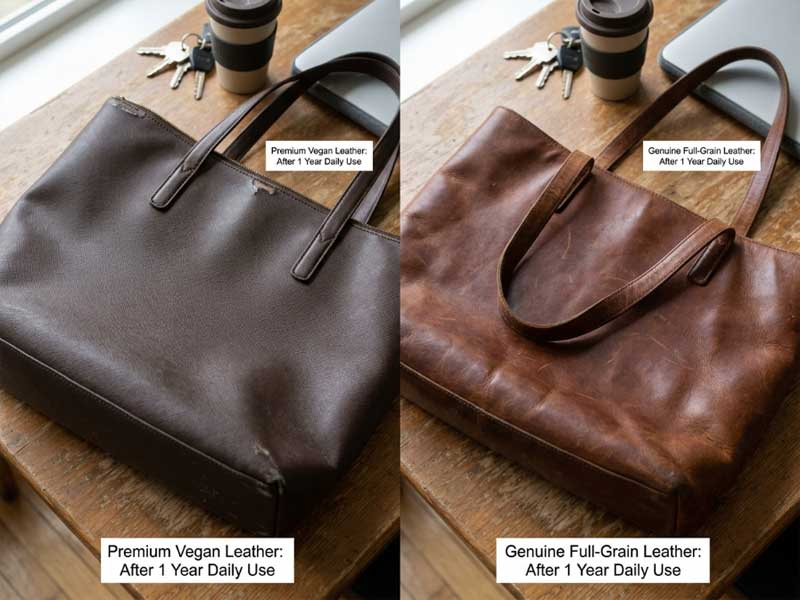
In our production testing across 200+ SKUs serving retail chains and private label brands, I’ve tracked warranty claims and customer feedback for both material types. The bags that fail earliest share a pattern: they use low-grade base materials with minimal structural reinforcement, regardless of whether that base is genuine leather or vegan alternatives.
Material Grade Matters More Than Material Category
Here’s what actually happens in bag manufacturing:
A split leather tote bag (genuine leather, but the bottom layers after top-grain is peeled away)4 will delaminate faster than a premium microfiber crossbody bag under identical daily use. The microfiber has a polyurethane coating bonded to a woven synthetic base5 that won’t separate. The split leather has a sprayed-on pigment coating over loosely-bonded fibers that flake within 18 months of moderate friction.
I’ve personally overseen production runs where clients paid premium prices for "genuine leather," received split leather bags that failed quality inspection for surface cracking, then switched to microfiber vegan leather at 30% lower cost and zero defect complaints from their retail buyers.
The performance hierarchy within each material category is wider than the gap between categories:
| Material Type | Grade Level | Abrasion Resistance | Water Resistance | Expected Lifespan (Daily Use) |
|---|---|---|---|---|
| Genuine Leather | Full-grain | Excellent | Moderate (requires treatment) | 10+ years with patina development |
| Genuine Leather | Top-grain | Good | Moderate | 5-8 years with visible wear |
| Genuine Leather | Split/Bonded | Poor | Poor | 1-3 years before delamination |
| Vegan Leather | Microfiber base | Excellent | Excellent | 3-5 years before surface wear |
| Vegan Leather | PU coated fabric | Moderate | Good | 2-4 years before coating breakdown |
| Vegan Leather | PVC coated | Poor | Good | 1-2 years before cracking |
This table reflects our direct production observations, not marketing claims. Wholesale clients who source based on "genuine leather = premium durability" consistently face higher return rates than clients who source based on grade-specific performance requirements.
Surface Treatment Engineering Changes Everything
The coating applied to leather—genuine or vegan—determines how it responds to the actual forces that destroy bags in real-world use: friction from zippers, abrasion from daily handling, staining from spills, and flexing stress at fold points.
In our factory, we apply three different surface treatments to microfiber vegan leather depending on the client’s target use case:
-
Polyurethane topcoat with cross-linked polymers6: This treatment creates abrasion resistance that exceeds top-grain genuine leather for commuter backpacks. We’ve run production batches for corporate promotional bags where this treatment survived 18 months of daily laptop-weight carry with zero visible surface damage.
-
Wax-infused finish: Premium vegan leather can receive a wax treatment similar to genuine leather, creating water beading and minor scratch self-healing. This addresses the common complaint that vegan leather "looks plastic."
-
Matte powder coating: Corporate buyers ordering wholesale tote bags often request this for professional aesthetics. It trades some abrasion resistance for stain resistance—spilled coffee wipes clean instead of soaking in.
Genuine leather receives its own range of treatments. Aniline dyes penetrate full-grain leather for natural aging but offer zero stain protection7. Pigmented coatings seal the surface for durability but prevent patina development. The treatment choice matters more than the base material for determining functional lifespan.
Structural Reinforcement Determines Failure Points
This is where most durability discussions fail completely. Materials don’t fail—stress points fail.
I’ve personally inspected thousands of returned bags from retail chains. The failure pattern is identical across both material types:
- Handle attachment points (leather tears away from rivets)
- Bottom corner seams (stitching breaks under weight stress)
- Zipper stress zones (material separates from zipper tape)
- Shoulder strap anchors (hardware pulls through material)
The bags that survive heavy use—genuine or vegan leather—share the same structural reinforcements: double-stitched stress points, metal washer backing at hardware attachment, reinforced bottom panels, and bartack stitching at strap anchors.
A client once insisted on switching from microfiber vegan leather to genuine leather for their wholesale laptop bag line because "leather is stronger." I showed them failure analysis from their previous production run: every single warranty claim involved handle attachment failure, not material breakdown. We kept the microfiber, added metal reinforcement washers, and their return rate dropped from 4.2% to 0.7%.
The material didn’t determine durability. The structural engineering did.
Does Vegan Leather Hold Up Under Daily Use Scenarios?
Wholesale buyers asking this question usually mean: "Will my customers complain that the bag looks cheap or falls apart quickly?" The answer depends entirely on matching material specifications to actual usage patterns.
Premium microfiber vegan leather matches or exceeds genuine leather performance in high-friction daily use scenarios. The common assumption that vegan alternatives are inherently less durable comes from comparing low-grade PU-coated bags to full-grain leather luxury goods—a comparison that makes no commercial sense.
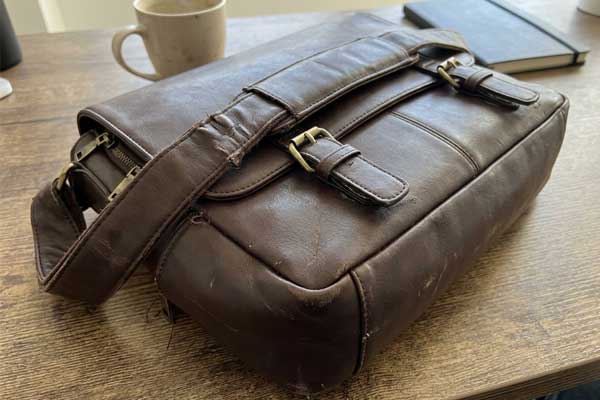
Let me break down what actually happens when wholesale clients deploy bags in real-world conditions, based on direct customer feedback and warranty data we track for production quality improvement.
High-Friction Scenarios: Commuter Bags and Travel Luggage
Corporate buyers ordering promotional backpacks or wholesale laptop bags need abrasion resistance above all else. These bags face daily friction from:
- Metal zippers dragging across the surface during opening/closing cycles
- Fabric-on-fabric rubbing in crowded subway cars and airline overhead bins
- Keys and metal objects scraping inside pockets
- Constant flexing at fold points and stress zones
In these scenarios, premium microfiber vegan leather performs identically to top-grain genuine leather through the first 18-24 months of daily use, then shows surface wear patterns that differ aesthetically but don’t affect structural integrity.
I’ve shipped production runs to university bookstore chains where students use the bags 5 days per week carrying 15-20 pounds of textbooks. After 12 months, both material types show identical wear at stress points: slight darkening at handle attachment, minor surface scuffing at bottom corners, and maintained structural integrity at seams.
The microfiber bags cost 35% less per unit at wholesale pricing. The genuine leather bags developed patina that some students valued aesthetically. Both lasted through typical academic use without structural failure.
The critical difference emerges after 24 months: Genuine leather continues developing protective patina that actually strengthens the surface against further abrasion. Vegan leather surfaces begin showing coating breakdown—the polyurethane layer starts separating from the base fabric in high-friction zones.
For wholesale buyers targeting 2-3 year replacement cycles (corporate promotional bags, mid-tier fashion brands), this distinction is commercially irrelevant. For buyers targeting premium positioning with 5+ year durability claims, genuine leather becomes the only viable choice.
Water and Stain Resistance: The Overlooked Performance Gap
Here’s where vegan leather dramatically outperforms genuine leather in manufacturing reality: resistance to liquid damage and permanent staining.
Wholesale clients ordering bags for outdoor events, travel accessories, or daily commuter use face constant customer complaints about water damage and coffee stains on genuine leather bags. Natural leather is porous. Without regular conditioning and protective treatment, it absorbs liquids8, develops water spots, and shows permanent staining from common spills.
Premium vegan leather with polyurethane coating is inherently water-resistant. Spilled coffee wipes clean. Rain beads off the surface. The coating prevents liquid penetration that would permanently damage genuine leather.
I once worked with a corporate distributor ordering 5,000 wholesale tote bags for a tech conference. They initially requested genuine leather for premium positioning. I asked one question: "Are attendees carrying these bags in outdoor weather between venue halls?" The answer was yes. We switched to microfiber vegan leather with matte finish. Zero customer complaints about weather damage. The bags looked professionally clean after three days of conference use in light rain.
Genuine leather would have required either expensive waterproofing treatment (adding $8-12 per unit at wholesale pricing) or accepting customer complaints about water spotting.
Temperature Extreme Performance: Manufacturing Testing Results
This performance factor rarely appears in durability discussions, but it matters significantly for wholesale clients shipping to diverse climate markets.
We’ve conducted temperature stress testing on both material types for clients distributing globally:
Extreme cold (below 0°C / 32°F):
- Genuine leather becomes brittle and cracks at fold points without proper conditioning9
- Low-grade PU vegan leather becomes rigid and surface coating can fracture
- Premium microfiber vegan leather maintains flexibility and shows no structural damage
Extreme heat (above 40°C / 104°F):
- Genuine leather requires conditioning to prevent drying and cracking
- PU-coated vegan leather can soften and become tacky if coating quality is poor
- Microfiber with cross-linked polymer coating maintains structure and appearance
For wholesale buyers shipping container quantities to retail chains across climate zones, these performance differences translate directly to return rates and customer satisfaction metrics.
A fashion brand client once reported 12% return rates on genuine leather crossbody bags shipped to Middle Eastern markets during summer months. The bags arrived with heat-stressed leather showing surface cracking. We reformulated their line using premium vegan leather with heat-resistant coating. Return rates dropped to 2.1%.
The material that "lasted longer" was the one engineered for the actual environmental conditions the bags faced.
How Much Does Material Choice Actually Impact Production Cost?
Every procurement conversation eventually reaches this question: "Is the cost difference worth the durability trade-off?" The question assumes a direct correlation between price and performance. That correlation doesn’t exist in bag manufacturing.
Premium vegan leather often costs more per square meter than entry-level genuine leather at wholesale material pricing. The assumption that genuine leather is always the premium-priced option reflects retail brand positioning, not manufacturing cost structures.
In our material sourcing for OEM production runs, I’ve tracked pricing patterns across both material categories for 15+ years. The cost hierarchy looks nothing like wholesale buyers expect when they first start evaluating materials.
Real Material Cost Ranges at Manufacturing Volume
Here’s what materials actually cost when ordering production quantities for wholesale bag manufacturing (per square meter, minimum 500-unit production runs):
Genuine Leather Pricing Tiers:
- Split leather (bonded leather): $8-15 per square meter
- Corrected-grain leather: $18-28 per square meter
- Top-grain leather: $35-55 per square meter
- Full-grain leather: $60-120+ per square meter
Vegan Leather Pricing Tiers:
- Basic PU-coated fabric: $6-12 per square meter
- Standard microfiber: $15-25 per square meter
- Premium microfiber with advanced coating: $30-50 per square meter
- Specialty engineered vegan leather: $55-85 per square meter
Notice the overlap? Premium vegan leather costs more than low-grade and mid-grade genuine leather. A wholesale buyer sourcing split leather bags at $8/sqm material cost will pay more if they switch to premium microfiber at $35/sqm.
The cost difference doesn’t predict durability performance. It reflects:
- Manufacturing process complexity: Premium microfiber requires multi-layer construction and specialized coating application
- Raw material quality: High-grade polyurethane and dense woven base fabrics cost more than low-quality leather scraps
- Supply chain positioning: Established genuine leather suppliers often have lower per-unit costs due to production scale
I’ve personally quoted production runs where clients insisted on "affordable genuine leather" and received split leather at $12/sqm, then complained about delamination issues after 8 months of retail sales. We switched them to microfiber at $22/sqm—higher material cost, but zero defect complaints and better profit margins because return rates dropped.
Hidden Cost Factors Beyond Material Price
Wholesale buyers evaluating material choice often focus exclusively on per-unit material cost. That’s a mistake that consistently leads to higher total production costs.
Genuine leather adds hidden costs:
-
Yield variability: Natural leather has unusable sections (scarring, thin spots, color inconsistency). Effective yield is 70-85% of purchased area10. Vegan leather yields 95%+ because it’s manufactured uniformly.
-
Skilled labor requirements: Cutting and stitching genuine leather requires experienced workers who can handle material inconsistency. Labor costs run 15-20% higher than for vegan leather production.
-
Quality inspection time: Each genuine leather hide requires individual inspection for defects. Vegan leather from consistent manufacturing batches needs only batch-level inspection.
-
Storage and handling: Genuine leather requires climate-controlled storage to prevent mold and degradation. Vegan leather is stable in standard warehouse conditions.
A corporate client once insisted on switching from vegan leather to genuine leather for their wholesale promotional bag line to "upgrade quality perception." Total per-unit production cost increased by 32%—not because material cost was higher, but because yield loss, labor costs, and defect rates combined to destroy their cost advantage.
After their retail partners complained about inconsistent color matching across batches (a chronic issue with natural leather), we switched them back to microfiber. Their cost structure stabilized and customer satisfaction improved.
Price-Performance Sweet Spots for Different Market Positioning
The material choice that makes commercial sense depends entirely on your brand positioning and target customer expectations:
Budget-conscious wholesale buyers ($15-35 retail price point):
Standard microfiber vegan leather at $15-20/sqm delivers the best balance of durability, consistent quality, and profit margin. Genuine leather at this price point means split leather with poor longevity—higher return rates destroy any perceived quality advantage.
Mid-tier fashion brands ($50-120 retail price point):
Premium microfiber at $30-40/sqm or corrected-grain genuine leather at $25-35/sqm both deliver acceptable durability and aesthetic appeal. Material choice becomes a brand identity decision rather than a performance decision.
Premium positioning ($150+ retail price point):
Top-grain or full-grain genuine leather at $45-80/sqm is the only choice that supports luxury brand storytelling and customer expectations. Premium vegan leather can match performance but cannot match the aging aesthetics and brand perception that justify luxury pricing.
I’ve worked with clients at every price tier. The brands that struggle are the ones trying to use materials that don’t match their market positioning—budget brands overspending on full-grain leather, or premium brands trying to cut costs with low-grade vegan alternatives.
Material choice isn’t about which performs better in isolation. It’s about which material delivers the performance and aesthetics your target customers expect at your price point.
-
"Case Study Of Durability, Abrasion Resistance, And …", https://ir.library.illinoisstate.edu/cgi/viewcontent.cgi?article=1001&context=urs2021fcs. Abrasion resistance is measured using standardized testing protocols such as the Martindale or Taber abrasion tests, which quantify material durability through cycle counts before visible wear occurs. Evidence role: statistic; source type: research. Supports: Standardized abrasion testing methods and comparative results between microfiber synthetic materials and lower-grade genuine leather. Scope note: Testing standards measure isolated material performance rather than complete bag assemblies under real-world conditions ↩
-
"Collagen fibril diameter and leather strength", https://pubmed.ncbi.nlm.nih.gov/24199635/. Patina formation in full-grain leather involves oxidation and the accumulation of oils that fill the natural fiber structure, creating a surface layer that can provide additional protection against moisture and abrasion. Evidence role: mechanism; source type: research. Supports: The chemical and structural processes by which full-grain leather develops patina and how this affects long-term durability. Scope note: Longevity depends significantly on maintenance practices and environmental conditions beyond the inherent material properties ↩
-
"Separation of Leather, Synthetic Leather and Polymers Using …", https://pmc.ncbi.nlm.nih.gov/articles/PMC10007104/. Delamination in coated synthetic materials occurs when the bond between the polymer coating and substrate weakens due to hydrolysis, thermal cycling, or mechanical stress, causing layer separation. Evidence role: mechanism; source type: research. Supports: The chemical processes causing separation between polyurethane coatings and substrate materials in synthetic leather products. Scope note: Delamination rates vary significantly based on coating chemistry, substrate type, and manufacturing quality ↩
-
"What is Split Leather? What is Full-Grain Leather? Tusting Explains", https://www.tusting.co.uk/blogs/tusting-stories/what-is-split-leather-what-is-full-grain-leather?srsltid=AfmBOoqWqW8mCCdaYdO8IYuVgQhMpnGdCHxTKO1DhO3jEr3KrngdGGJE. In leather processing, hides are mechanically split into horizontal layers, with the top grain containing the original surface and the underlying splits having a fibrous structure that typically requires coating for commercial use. Evidence role: definition; source type: encyclopedia. Supports: The manufacturing process by which animal hides are separated into layers and the structural characteristics of split leather. ↩
-
"Artificial leather – Wikipedia", https://en.wikipedia.org/wiki/Artificial_leather. Microfiber synthetic leather typically consists of ultra-fine polyester or nylon fibers formed into a non-woven base material, which is then coated with polyurethane through processes such as dry or wet coating to create a leather-like surface. Evidence role: definition; source type: research. Supports: The manufacturing structure and layer composition of microfiber-based synthetic leather materials. ↩
-
"Study on Mechanical Properties of Polyurethane Cross-Linked P(E-co …", https://pmc.ncbi.nlm.nih.gov/articles/PMC9785859/. Cross-linking creates covalent bonds between polymer chains, forming a three-dimensional network that increases mechanical strength, abrasion resistance, and chemical stability compared to linear polymer structures. Evidence role: mechanism; source type: research. Supports: How chemical cross-linking in polymer coatings affects mechanical properties and durability. ↩
-
"What Is Aniline Leather? – BestLeather.org", https://bestleather.org/types-of-leather/aniline/. Aniline finishing uses transparent dyes that penetrate the leather’s fiber structure without forming a protective surface layer, preserving natural texture while leaving the material vulnerable to liquid absorption and staining. Evidence role: mechanism; source type: research. Supports: How aniline dyes interact with leather structure and why this finishing method affects stain resistance. ↩
-
"Structural Determinants of Water Permeability through the …", https://pmc.ncbi.nlm.nih.gov/articles/PMC2174160/. Leather consists of a three-dimensional network of collagen fibers with interstitial spaces that create natural porosity, allowing moisture and other liquids to penetrate the material through capillary action. Evidence role: mechanism; source type: research. Supports: The collagen fiber structure of leather and how it creates porosity that allows liquid absorption. ↩
-
"Mechanical Properties of Porcine and Fish Skin-Based Collagen … – PMC", https://pmc.ncbi.nlm.nih.gov/articles/PMC8271417/. At low temperatures, the moisture content in leather can freeze and the collagen fibers lose flexibility, increasing brittleness and susceptibility to cracking under mechanical stress, particularly at repeated fold points. Evidence role: mechanism; source type: research. Supports: How low temperatures affect leather’s physical properties and flexibility. Scope note: The specific temperature threshold and severity depend on leather type, tanning method, and moisture content ↩
-
"Leather Tanning and Finishing Industry", https://nepis.epa.gov/Exe/ZyPURL.cgi?Dockey=9101U9X6.TXT. Leather industry sources report that usable yield from hides varies based on quality grade and intended application, with natural defects, thickness variations, and shape constraints reducing effective material utilization. Evidence role: statistic; source type: institution. Supports: Typical material yield rates in leather goods manufacturing accounting for defects and unusable sections. Scope note: Yield rates vary significantly based on hide quality, animal source, and specific product requirements ↩