Skip to content
I’ve handled dozens of customer complaints about faded zippers, tarnished buckles, and discolored chain straps — often from buyers who thought they’d covered their bases with lab test reports and premium pricing. The frustration in their emails is always the same: "The samples looked perfect. How did 5,000 units arrive with rust spots after three months?" Here’s the uncomfortable truth: test reports can’t predict how your hardware will age in real-world conditions, and paying more doesn’t guarantee durability. The gap between laboratory conditions and daily use creates blind spots that catch even experienced importers off guard.
Hardware fading happens when the electroplating layer — the protective metal coating on your zippers, buckles, and chains — breaks down through oxidation, chemical exposure, or mechanical wear1. Preventing it requires converting test data into enforceable supplier commitments: specify exact plating thickness in microns (not just "meets standards"), confirm your samples and bulk production use identical hardware batches, document anti-tarnish coating types in writing, and retain physical sample hardware for side-by-side comparison during final inspection. Testing alone won’t protect your order — traceable material sourcing and contractual accountability will.
You’re reading this because you’re probably evaluating quotes right now, trying to figure out whether your supplier’s pricing reflects genuine quality or just confident promises. Let me walk you through how hardware actually fails in the field, what standard tests miss entirely, and the specific verification steps that have saved my clients from accepting defective shipments.
What Actually Causes Handbag Hardware to Fade or Tarnish?
When a buyer contacts me after discovering faded hardware in their inventory, the first question I ask isn’t about chemistry — it’s about context. Fading looks different depending on whether it happens during storage, daily use, or after specific chemical exposure, and identifying the pattern tells you where your quality control failed.
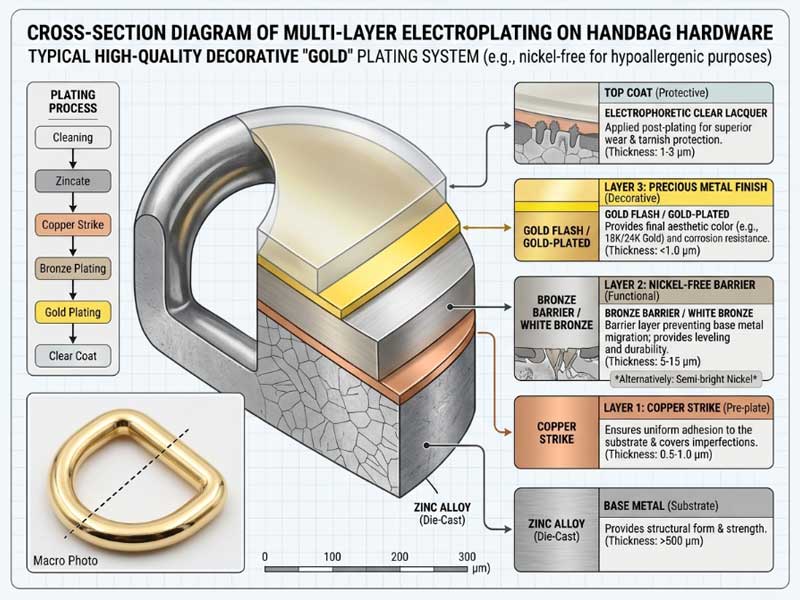
Hardware fading occurs when the thin electroplated metal layer (typically nickel, zinc alloy, or brass covered with gold, silver, or gunmetal finish) loses its protective barrier against oxygen, moisture, or reactive chemicals. This breakdown manifests as discoloration, rust spots, or complete coating loss, usually triggered by inadequate plating thickness, chemical incompatibility with bag materials, or environmental exposure beyond the hardware’s design limits.
The Three Scenarios I See Most Often
From tracking complaint patterns over the years, hardware fading clusters into three distinct failure modes:
1. Gradual Oxidation During Normal Use (2–6 Months)
This is the classic "it looked fine at inspection but customers are returning bags now" scenario. The hardware passes initial checks but develops a dull, grayish patina or bronze-colored spots where hands repeatedly touch zippers and clasps. The culprit is almost always insufficient plating thickness — your supplier quoted electroplating but didn’t specify whether you’re getting 0.3 microns (bargain basement) or 3+ microns (commercial durability standard).
I once worked with a European retailer whose mid-range tote bags started showing zipper discoloration after eight weeks of daily use. Their supplier had provided a test report showing "nickel-free electroplating compliant with EN 18112." Technically accurate — but the report measured nickel release, not plating durability. When we cut open a faded zipper and sent it for cross-sectional analysis, the plating layer measured 0.5 microns. For context, quality fashion hardware typically uses 2–5 micron plating for moderate wear resistance3.
2. Storage-Related Tarnishing (Before Customer Use)
This catches buyers completely off guard — hardware discolors while sitting in your warehouse or during ocean freight. You open a container six weeks after production and find green oxidation on brass components or black spots on silver-finish buckles.
The issue here isn’t use-related wear; it’s chemical reactions between hardware and other bag materials. Leather tanning chemicals (especially chrome-tanned leather), dye transfer from synthetic linings, and sulfur compounds in certain rubber components can all accelerate oxidation4. Standard lab tests evaluate hardware in isolation — they don’t simulate your hardware touching your specific leather grade for 45 days in 80% humidity.
I’ve seen this wreck shipments of vegan leather crossbody bags where the PU coating contained plasticizers that reacted with zinc alloy hardware. The supplier’s test report covered salt spray resistance but said nothing about material compatibility.
3. Rapid Degradation from Chemical Contact
This is the dramatic version: hardware that looks perfect until a customer applies hand sanitizer, perfume, or cleaning spray, then shows visible damage within hours or days.
Alcohol-based products, acidic cosmetics, and chlorinated cleaning agents break down anti-tarnish coatings rapidly, especially on fashion-grade hardware where cost constraints limit protective layer thickness. I ask buyers planning beach bags or gym totes whether they’ve tested hardware against sunscreen and chlorinated pool water — most haven’t, because standard corrosion tests use neutral salt spray, not the specific chemicals their customers actually carry.
Why "Expensive Hardware" Still Fails
Here’s where buyers often get burned: assuming price correlates with durability. In reality, a supplier quoting $0.80 per zipper versus $0.40 doesn’t automatically mean better plating — it might mean fancier design, brand-name components, or just higher markup.
The fundamental problem is that most quotations list "electroplated hardware" without specifying:
- Base metal composition (zinc alloy, brass, iron alloy — each oxidizes differently5)
- Plating layer sequence (copper undercoat + nickel + chrome, or direct plating6)
- Plating thickness in microns (the only number that predicts wear life)
- Anti-tarnish topcoat type (lacquer, e-coating, passivation treatment7)
When I review supplier quotes with clients, I circle these four items and ask: "Can you get these details in writing before approving production?" The answer is usually no — which means you’re buying hardware quality blind, regardless of unit price.
Why Standard Test Reports Miss the Problems That Actually Happen?
I need to be direct here: the test report your supplier provides is designed to prove compliance with legal safety standards, not predict how your hardware performs in your customer’s handbag. This isn’t fraud — it’s a structural limitation of standardized testing that most buyers don’t understand until they’re managing a product recall.
Standard hardware testing (typically salt spray corrosion resistance per ASTM B117 or ISO 9227)8 measures how isolated metal samples withstand controlled saline mist exposure for 24–96 hours. These tests validate baseline corrosion resistance but don’t simulate: multi-material chemical interactions inside assembled bags, exposure to cosmetics and cleaning products, mechanical wear combined with environmental stress, or aging beyond the test duration. Passing a 48-hour salt spray test doesn’t mean hardware will survive 6 months of daily use plus leather tanning chemical contact.

The Four Blind Spots in Lab Testing
Blind Spot #1: Single-Material Testing vs. Real Assembly Conditions
Your lab report tests the zipper. It doesn’t test the zipper sewn onto chrome-tanned leather, stored against polyester lining, inside a humid shipping container for six weeks.
I worked a complaint case where a supplier’s hardware passed 72-hour salt spray testing but developed green corrosion during sea freight. The investigation revealed that the vegetable-tanned leather straps (marketed as premium material) contained residual acidic compounds that accelerated brass oxidation. The test chamber used distilled water; the shipping container had humidity plus organic acids.
This is why I tell buyers: if you’re using specialty materials (vegan leather with specific plasticizers, chrome-free tanned leather, recycled fabrics with unknown chemical residues), you need material compatibility testing that puts your actual hardware against your actual materials in accelerated aging conditions. Standard reports won’t catch this.
Blind Spot #2: Test Duration vs. Warranty Period Mismatch
A 48-hour salt spray test roughly simulates a few months of moderate coastal climate exposure9. If you’re selling bags with 12-month warranty coverage, your test duration covers maybe 20% of the liability period you’re accepting.
Longer test durations exist (480-hour tests, 1000-hour tests), but they cost more and take longer to complete. Most suppliers default to the minimum acceptable standard unless you specify otherwise in your technical requirements.
Here’s the conversation I have with clients:
Me: "What’s your expected product lifespan before acceptable wear?"
Client: "At least 18–24 months of regular use."
Me: "Your test report shows 48-hour salt spray. That validates basic corrosion resistance but doesn’t predict two-year aging."
Client: "So what do I test for?"
Me: "Either extend test duration to 480+ hours, or accept that you’re validating baseline quality but still need supplier accountability through batch consistency and retained samples."
Blind Spot #3: Chemical Resistance Testing Gaps
Standard corrosion tests use neutral pH salt water. Your customer’s handbag encounters:
- Hand sanitizer (60-95% alcohol)10
- Perfume (alcohol + fragrance compounds + oils)
- Sunscreen (chemical UV filters + emulsifiers)
- Sweat (lactic acid + salts + urea)11
- Cleaning sprays (surfactants + solvents)
I’ve never seen a supplier voluntarily test hardware against this chemical cocktail unless the buyer specifically requests it. If you’re manufacturing bags for gym use, travel, or beach scenarios, standard salt spray testing tells you almost nothing about real-world durability12.
One Amazon seller I advised was getting returns on weekender bags with "rusted zippers" — but the oxidation patterns were irregular and rapid, not the gradual uniform corrosion from environmental exposure. We eventually traced it to customers storing bags in gym lockers where chlorine vapor from pool areas accelerated deterioration. The hardware passed standard tests because it was never exposed to chlorinated environments during testing.
Blind Spot #4: Batch Consistency Assumptions
Here’s the scenario that wrecks importers: Your supplier sends samples made with Batch A hardware. Testing confirms quality. You approve production. Production ships using Batch B hardware from a different sub-supplier.
Test reports validate the specific sample tested — they say nothing about whether your bulk order uses identical materials. Unless your purchase contract explicitly states "production hardware must be from the same batch/supplier as approved samples," you have no enforcement mechanism when quality drops.
I’ve reviewed contracts where buyers paid for testing but forgot to include hardware batch traceability clauses. The test report became worthless because there was no documented link between the tested sample and the shipped goods.
What Tests Actually Prove (And What They Don’t)
Let me summarize this in plain terms:
| What Standard Tests Validate | What They DON’T Predict |
|---|---|
| Base metal corrosion resistance in neutral conditions | How hardware ages when touching leather, lining, or adhesives |
| Minimum electroplating quality at time of testing | Durability over your warranty period (test is usually much shorter) |
| Compliance with safety regulations (nickel release, lead content) | Resistance to customer-applied chemicals (sanitizer, cosmetics) |
| Performance of the specific sample tested | Consistency across thousands of units from different batches |
The solution isn’t to stop testing — it’s to treat test reports as baseline compliance proof, not durability guarantees, and layer on supplier accountability measures that address the blind spots.
How Do I Ask the Right Questions Before Placing My Order?
When I’m helping a buyer evaluate supplier quotes, I don’t start by asking for test reports — I start by clarifying what problem they’re actually trying to solve. The specifications you need depend entirely on your target price segment, expected use environment, and acceptable aging timeline. A $15 wholesale tote bag and a $150 leather handbag should not have the same hardware requirements, but buyers often copy-paste technical specs without understanding the cost implications.
Effective hardware quality control begins with defining three parameters: your target retail price point (which determines cost-per-unit budget for premium plating), your customer’s use environment (daily commute vs. occasional formal use vs. outdoor/travel), and your acceptable oxidation threshold (no visible change for 6 months vs. gradual patina is acceptable). These answers convert subjective "quality" debates into specific material choices, measurable plating thickness, and enforceable inspection criteria.
The Three Questions That Frame Your Requirements
I developed this framework after watching too many buyers argue with suppliers about "quality" without defining what quality actually means for their specific product. Here’s what I ask:
Question 1: What’s Your Target Retail Price, and What Hardware Budget Does That Allow?
This sounds commercial, not technical — but it’s the most important specification conversation.
If you’re developing $30 retail tote bags sold through discount chains, you probably have $0.30–0.50 per bag for all hardware combined (zippers, buckles, feet, magnetic snaps). At that budget, you’re looking at basic zinc alloy with 0.5–1 micron nickel plating and minimal anti-tarnish coating. This hardware will develop patina with regular use within 6–12 months. That’s not defective — it’s the natural aging of budget-grade electroplating.
If you’re producing $180 retail leather handbags for department stores, you can budget $2.50–4.00 per bag for hardware, which allows brass base metal with 3–5 micron plating, proper anti-tarnish topcoat, and potentially branded hardware components. This should maintain appearance for 18–24 months of regular use.
I tell buyers: "Don’t ask your supplier for luxury durability at economy pricing. Ask what plating thickness and anti-tarnish protection your budget actually allows, then decide if that matches your quality positioning."
Question 2: What Conditions Will Your Bags Actually Experience?
Walk through your customer’s likely usage:
- Office commute bag: Daily handling, occasional rain exposure, stored in climate-controlled spaces
- Beach/travel tote: Sunscreen contact, saltwater spray, UV exposure, temperature extremes
- Gym/active bag: Sweat exposure, frequent cleaning, possible chlorine vapor contact
- Evening clutch: Minimal use frequency, cosmetic contact, long-term storage between uses
A supplier who understands this will adjust recommendations. For beach bags, you need stainless steel or marine-grade coatings, not standard nickel plating. For evening bags, you can accept hardware that looks pristine for 50 uses but might tarnish if used daily for months.
Most buyers describe their product ("crossbody bag") without describing the use case, so suppliers default to generic mid-grade specifications that might be totally wrong for the actual environment.
Question 3: What Level of Aging Can You Accept, and When?
This is where I separate realistic buyers from those heading toward disputes.
I frame it this way: "Metal hardware will age. The question isn’t ‘will it ever change’ but ‘how much change, and when, makes it defective versus normal wear?’"
Options might be:
- No visible oxidation for 6 months of daily use → Requires premium plating (3+ microns) plus quality topcoat; adds $0.80–1.50 per bag to hardware cost
- Gradual patina acceptable after 3–4 months → Standard commercial plating (1.5–2 microns); typical mid-market cost
- Vintage/distressed look is brand-appropriate → Can use brass or copper that develops patina quickly; might reduce hardware cost but requires marketing that positions aging as desirable
When buyers tell me "I want hardware that never fades," I ask: "For how long, and what does ‘never’ mean — no detectable change for 1 year, 2 years, 5 years?" That forces concrete thinking instead of aspirational absolutes.
Converting Answers Into Supplier Communication
Once you’ve clarified these three parameters, you can have productive technical conversations. Here’s how I translate buyer requirements into supplier questions:
Instead of: "Do you use good quality hardware?"
Ask: "What’s the electroplating thickness in microns for zippers and buckles in my price bracket? Can you provide cross-sectional analysis reports?"
Instead of: "Will this hardware pass testing?"
Ask: "Can you confirm that sample hardware and bulk production will come from the same batch and supplier? How do you trace hardware lot numbers through production?"
Instead of: "I need hardware that doesn’t tarnish."
Ask: "What anti-tarnish coating do you apply after electroplating — lacquer, e-coating, or passivation treatment? What’s the coating thickness specification?"
Instead of: "Send me your test reports."
Ask: "Can you provide salt spray test results for the specific hardware grade you’re quoting, plus confirmation that you
-
"Corrosion Fundamentals – NASA", https://public.ksc.nasa.gov/corrosion/corrosion-fundamentals/. Materials science research documents that electroplated coatings fail through combined mechanisms including galvanic corrosion, environmental oxidation, and mechanical wear that compromises protective layer integrity. Evidence role: mechanism; source type: research. Supports: the chemical and physical mechanisms by which electroplated metal coatings degrade over time. ↩
-
"EU – EN 1811 Testing of Nickel Release Products with Prolong", https://www.tuv.com/regulations-and-standards/en/eu-en-1811-testing-of-nickel-release-products-with-prolonged-skin-contact.html. European standard EN 1811 establishes test methods and limits for nickel release from articles intended for direct and prolonged skin contact, adopted to reduce allergic contact dermatitis incidence. Evidence role: definition; source type: government. Supports: the regulatory standard governing nickel release from metal products in contact with skin. ↩
-
"Hardware Plating Thickness: Microns Matter More Than …", https://www.selvane.co/blogs/knowledge/hardware-plating-thickness-microns-matter-more-than-marketing?srsltid=AfmBOoooRX5QxZa1IhtjOwkQn6Jl5FLrXflDGZt3MkoSAoF6d26nqLl3. Industry technical specifications establish typical electroplating thickness ranges for metal fashion accessories based on intended wear conditions and expected service life. Evidence role: general_support; source type: research. Supports: typical electroplating thickness ranges for fashion hardware and their correlation with wear resistance. Scope note: Standards may vary by region and specific hardware type; exact thickness requirements depend on base metal composition and intended use environment. ↩
-
"Thermochemistry of Sulfur-Based Vulcanization and of … – PMC", https://pmc.ncbi.nlm.nih.gov/articles/PMC9916552/. Materials science literature documents that residual chromium salts from leather tanning, sulfur compounds from rubber vulcanization, and certain organic dyes can create localized chemical environments that accelerate electrochemical corrosion of metal components through pH alteration and reactive species formation. Evidence role: mechanism; source type: research. Supports: chemical mechanisms by which leather processing chemicals, textile dyes, and rubber additives promote metal corrosion. ↩
-
"Initial oxidation of brass induced by humidified air – PMC – NIH", https://pmc.ncbi.nlm.nih.gov/articles/PMC3587402/. Corrosion science establishes that zinc alloys, brass (copper-zinc), and iron-based alloys exhibit different oxidation rates and mechanisms due to their varying electrochemical potentials and passive film formation characteristics in atmospheric environments. Evidence role: mechanism; source type: research. Supports: the distinct electrochemical and oxidation behaviors of different base metals used in hardware manufacturing. ↩
-
"Chrome plating – Wikipedia", https://en.wikipedia.org/wiki/Chrome_plating. Electroplating technical literature describes conventional decorative plating systems using sequential copper (leveling and adhesion), nickel (corrosion resistance and brightness), and chromium (wear resistance and final appearance) layers, each serving distinct protective and aesthetic functions. Evidence role: mechanism; source type: research. Supports: standard multi-layer electroplating systems and the functional role of each coating layer. ↩
-
"Passivation (chemistry)", https://en.wikipedia.org/wiki/Passivation_(chemistry). Surface finishing literature documents multiple anti-tarnish technologies including organic lacquer coatings (polymer barriers), electrocoating (electrophoretic polymer deposition), and chemical passivation (oxide layer formation), each providing distinct corrosion protection mechanisms and durability profiles. Evidence role: definition; source type: research. Supports: common surface treatment methods used to prevent tarnishing and corrosion of metal hardware. ↩
-
"Salt spray test", https://en.wikipedia.org/wiki/Salt_spray_test. ASTM International and ISO publish standardized salt spray testing protocols that define controlled exposure conditions for evaluating metal coating corrosion resistance, widely adopted for quality control in manufacturing. Evidence role: definition; source type: institution. Supports: the standardized test methods for evaluating corrosion resistance of metallic coatings. ↩
-
"Accelerated Test Method for Corrosion Protective Coatings Project", https://techport.nasa.gov/projects/14798. Corrosion engineering research notes that accelerated salt spray testing provides relative ranking of coating performance, though direct time-to-field-exposure correlations vary significantly with actual environmental conditions, material systems, and coating types. Evidence role: general_support; source type: research. Supports: approximate correlations between accelerated salt spray test duration and estimated field exposure duration. Scope note: Exact correlation ratios are highly variable and depend on specific environmental factors, coating composition, and substrate materials; standardized tests provide comparative rather than absolute predictive data. ↩
-
"Hand Sanitizer Facts | Clean Hands – CDC", https://www.cdc.gov/clean-hands/data-research/facts-stats/hand-sanitizer-facts.html. Public health agencies specify that alcohol-based hand sanitizers should contain 60-95% alcohol (ethanol or isopropanol) to effectively reduce microorganisms on hands, establishing this range as the standard formulation. Evidence role: statistic; source type: government. Supports: the recommended alcohol concentration range in hand sanitizers for antimicrobial effectiveness. ↩
-
"Physiology of sweat gland function: The roles of … – PMC", https://pmc.ncbi.nlm.nih.gov/articles/PMC6773238/. Physiological research confirms that eccrine sweat consists primarily of water with dissolved salts (sodium chloride, potassium), organic acids (primarily lactic acid), and nitrogenous compounds (urea and ammonia), creating a mildly acidic and corrosive environment. Evidence role: definition; source type: research. Supports: the principal chemical constituents of human perspiration. ↩
-
"Correlation between Laboratory-Accelerated Corrosion … – PMC", https://pmc.ncbi.nlm.nih.gov/articles/PMC9784768/. Corrosion testing literature acknowledges that neutral salt spray testing provides comparative coating quality assessment but has limited correlation with field performance under specific chemical exposures (cosmetics, sanitizers, chlorinated environments) not simulated in standardized test protocols. Evidence role: general_support; source type: research. Supports: the recognized limitations of standardized salt spray testing for predicting performance under specific chemical exposure conditions. Scope note: While this limitation is recognized in technical literature, specific quantitative correlations between salt spray performance and resistance to particular consumer product chemicals remain product-specific and poorly standardized. ↩