Skip to content
Every week, I receive messages from entrepreneurs who’ve found the "perfect bag design" on Pinterest or Instagram, and they’re ready to turn it into their signature product. The conversation usually starts with excitement—and then hits a wall when I send the prototype quotation. "Why does just one sample cost this much? Can’t you deduct it from my bulk order later?" I understand the frustration. When you’re bootstrapping a brand with limited capital, every dollar matters. But here’s what I’ve learned from walking dozens of founders through their first custom bag project: prototype costs aren’t inflated manufacturing fees—they’re risk insurance that protects you from expensive mistakes during mass production.
A custom bag prototype typically costs between 3 to 8 times the unit price of your eventual bulk order1, depending on material complexity, hardware specifications, and structural engineering requirements. This investment covers pattern development, material sourcing at non-negotiable minimum order quantities, manual assembly labor, and technical adjustments—costs that cannot be recovered or distributed across your future production volume. You’re not paying for a single bag; you’re funding the knowledge transfer and quality validation that determines whether your product concept is commercially viable.
I’m writing this because I’ve seen too many promising brands stumble at this exact stage—not because their designs were flawed, but because they didn’t understand what they were actually purchasing when they paid for prototyping. Let me walk you through the real cost drivers, the hidden variables your supplier can’t explain in a two-sentence email, and how to evaluate whether a prototype quotation reflects genuine manufacturing complexity or unnecessary markups.
Why Can’t Prototype Costs Be Deducted from My Bulk Order?
I get asked this question more than any other, and it always comes from a reasonable place. If you’re ordering 1,000 bags eventually, why shouldn’t that first sample count as unit number one?
The expectation that prototype fees should offset bulk production costs stems from a fundamental misunderstanding of how small-batch and large-scale manufacturing operate on completely different cost structures. When you order 1,000 bags, our factory negotiates bulk material pricing, runs continuous production lines with specialized workers, and distributes fixed costs (pattern making, quality control setup, packaging design) across the entire order. Your per-unit cost drops dramatically because we’re amortizing those one-time investments.
Prototyping operates in reverse. Every cost element that benefits from volume in mass production becomes a concentrated, non-recoverable expense in sampling.
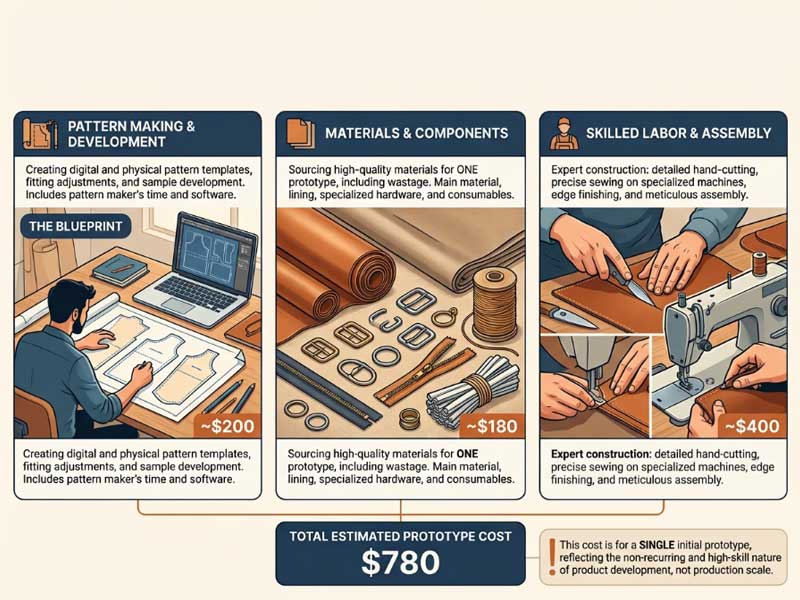
Let me break down the three cost categories that make prototyping financially separate from your eventual bulk order:
1. Pattern Development Is a One-Time Intellectual Investment
When you send me a reference photo or a sketch, my pattern maker needs to reverse-engineer the structural logic of that design. This isn’t tracing an outline—it’s translating a 2D image into precise cutting templates that account for seam allowances, material stretch behavior, and assembly sequences.
For a basic tote bag, this takes 3-4 hours of specialized labor. For a structured handbag with multiple compartments, curved panels, and reinforced bases, we’re looking at 8-12 hours.2 This pattern becomes your product’s "DNA," but it only gets created once during prototyping.
In bulk production, this cost disappears—we reuse the same pattern for 1,000 bags. But in prototyping, you’re bearing 100% of that engineering cost for a single unit.
2. Material Procurement Hits Minimum Order Quantity Barriers
This is where many first-time founders get surprised. You want a sample bag made from Italian vegetable-tanned leather with antique brass hardware and custom woven lining. Perfect—except our leather supplier’s minimum order is 15 square feet (enough for 8-10 bags), the hardware manufacturer requires a 100-piece minimum, and the lining mill won’t custom-weave anything under 50 meters3.
We can’t buy "one bag’s worth" of materials. We purchase the supplier minimums, use what’s needed for your prototype, and the rest becomes dead inventory we likely can’t repurpose for other clients (because your specifications are unique to your design).
In bulk production, those minimums disappear into your order volume. For a prototype, you’re financing material purchases at the worst possible economy of scale.
3. Manual Assembly Versus Production Line Efficiency
Our factory workers who handle bulk production are trained on repetitive tasks—one person attaches straps all day, another installs zippers, a third handles edge painting. This division of labor creates speed and consistency.
Prototype assembly works differently. A senior craftsperson builds your entire bag from start to finish, pausing frequently to problem-solve fit issues, adjust tension settings on different material thicknesses, and document assembly sequences for future production workers. What takes 12 minutes per bag on a production line takes 90-120 minutes during prototyping4.
We can’t recover that labor investment from your bulk order because the skills required are fundamentally different. You’re paying for technical expertise, not just hands-on construction time.
What Variables Actually Determine My Prototype Cost?
I’ve quoted projects where clients were shocked that a "simple drawstring pouch" cost nearly as much to prototype as a structured crossbody bag. The confusion makes sense if you’re judging complexity purely by visual appearance, but manufacturing cost drivers operate on a different logic.
Prototype costs are determined by material sourcing difficulty, hardware customization requirements, and construction technique complexity—not by how "fancy" the finished bag looks. A minimalist design using exotic materials and invisible stitching techniques often costs more to prototype than a visually elaborate bag built from standard components.
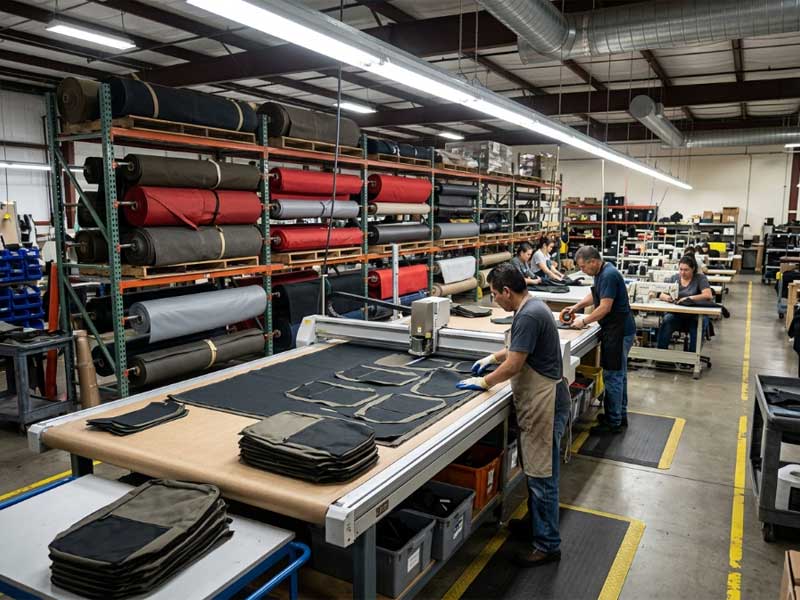
Based on projects I’ve quoted over the past two years, here are the three variables that create the widest cost swings:
Material Category and Sourcing Complexity
The price difference between genuine leather and PU leather isn’t just 20-30%—it’s often 300-500% when you factor in prototype-scale procurement5.
Genuine leather requires us to inspect hides for uniform thickness and color consistency (since we can’t blend variations across multiple bags in a sample run). We’re also purchasing full hides or large panels when we only need fragments, creating significant waste that can’t be absorbed into other projects.
PU leather and synthetic materials offer better prototype economics because suppliers stock them in smaller cuts and color variations are controlled during manufacturing (not inherited from animal hides).
Specialty fabrics like ballistic nylon, waterproof canvas, or technical meshes often carry similar minimum order barriers as genuine leather but with added lead time challenges—our textile suppliers might need 2-3 weeks to source niche materials versus 2-3 days for standard options.
The material you choose doesn’t just affect the bag’s final aesthetic; it determines whether we’re working with a $5/yard baseline or a $35/yard investment before we’ve even cut a single panel.
Hardware Specification and Customization Level
Hardware costs in prototyping follow a brutal economic rule: standard components are cheap; anything custom or semi-custom multiplies costs by 5-10x.
When clients ask for "rose gold zippers with our logo engraved on the pulls" or "magnetic closures in a specific size not available off-the-shelf," they’re triggering minimum order quantities from hardware suppliers that dwarf what we need for a single prototype.
Here’s a real example: Standard YKK zippers cost us about $0.40 per unit when purchased in prototype quantities (10-20 pieces). Custom-colored zippers with branded pulls require a 500-piece minimum order, pushing the per-unit cost to $2.806—but we only need two zippers for your sample. That $5.60 in zippers has now cost $1,400 in procurement.
We have three options:
- Source standard hardware that approximates your vision (fastest, cheapest)
- Order custom hardware minimums and absorb the excess cost (adds $200-800 to prototype fee)
- Delay prototyping until you’ve finalized bulk production plans and can justify custom hardware orders
Most founders choose option 1 for prototyping, then upgrade to custom hardware during bulk production when the per-unit economics make sense.
Construction Technique and Assembly Complexity
This is where "simple-looking" designs can hide expensive prototyping costs. A clean, minimalist tote bag with invisible seams and hand-burnished edges requires more skilled labor and time than a utilitarian backpack with visible stitching and standard seam allowances.
Hand-stitching, edge painting, turned-and-topstitched seams, and piped edges add 40-90 minutes of labor per bag compared to standard machine-sewn construction. These techniques aren’t just aesthetic choices—they’re engineering decisions that determine whether your bag can be manufactured consistently at scale.
During prototyping, we’re not just building the bag; we’re documenting whether these techniques can be replicated by production-line workers (who have different skill sets than our sample room craftspeople). If your design requires processes that only senior artisans can execute, your bulk production costs will reflect that constraint.
I always recommend that founders prioritize construction methods during prototyping, not just final appearance. The sample you approve becomes the manufacturing standard we need to hit across thousands of units.
How Do I Know If a Prototype Quote Is Fair or Inflated?
I’ve had clients forward me quotations from competitors that were 40% lower than mine, asking if I could match them. Sometimes I can—because the other quote was for a simplified version of their original spec. Other times I can’t, because matching that price would mean cutting corners that guarantee production failures later.
Fair prototype pricing reflects transparent cost allocation across materials, labor, and technical validation—not arbitrary markups based on what the market will bear. Your goal isn’t to find the cheapest quote; it’s to find pricing that accurately represents the manufacturing complexity you’re asking for.
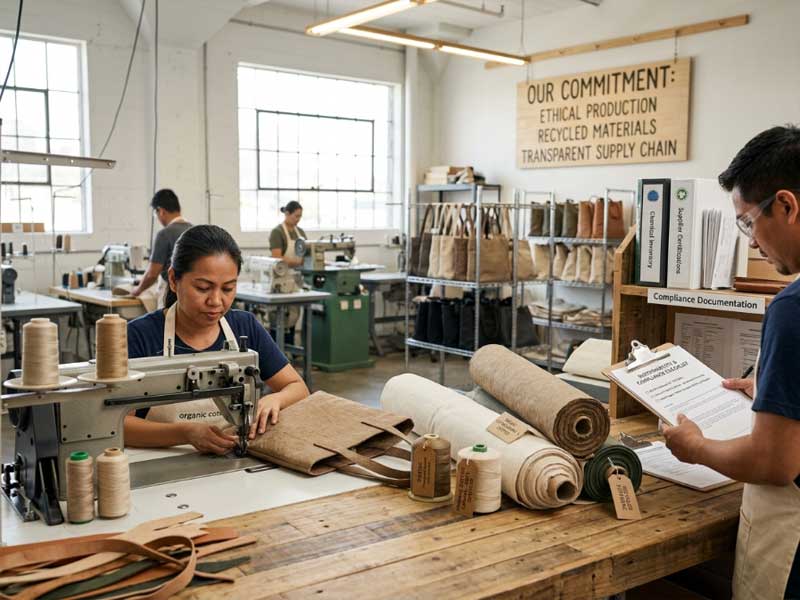
Here’s how I evaluate quotations when founders ask me for second opinions:
Ask What’s Included Beyond the Physical Sample
A legitimate prototype quotation should break down exactly what you’re receiving:
- Pattern engineering and technical drawings (these become production documents)
- Material procurement (specify quantities and whether excess materials are included or retained by factory)
- Number of revision rounds (does the quote cover one build-test-adjust cycle or multiple iterations?)
- Documentation deliverables (will you receive pattern files, material specifications, and assembly instructions?)
If a quote just says "one prototype: $280," you don’t know whether pattern revisions cost extra, whether they’re using genuine materials or substitutes, or how many adjustment rounds are included.
I’ve seen projects where the "cheap prototype" only covered initial construction—every adjustment request triggered additional fees that eventually exceeded higher-priced quotes that included comprehensive revision cycles.
Compare Material Specifications Against Your Requirements
This is where low-ball quotes often hide substitutions. If you’ve specified Italian vegetable-tanned leather and the quote seems suspiciously affordable, ask explicitly: "What leather grade and origin are you quoting?"
Genuine cost reductions come from three legitimate sources:
- The supplier has existing material stock that matches your needs (eliminates minimum order premiums)
- They’re proposing alternative materials with similar performance characteristics at lower cost
- They’ve identified construction simplifications that don’t compromise design intent
Fake cost reductions come from:
- Planning to use lower-grade materials than specified
- Quoting standard hardware when you’ve requested custom options
- Skipping pattern development by "eyeballing" dimensions from your reference photo
Always request material sourcing details before accepting a quote. A factory comfortable discussing their supply chain is usually pricing honestly; vague responses about "similar materials" are red flags.
Evaluate the Balance Between Prototype and Bulk Production Pricing
Here’s a useful sanity check: If a factory quotes $180 for a prototype and $165 for bulk production units (at 500-piece order quantity), something doesn’t align with manufacturing economics.
Legitimate prototype-to-bulk ratios typically range from 3:1 to 8:1 depending on material and hardware customization7. A simple canvas tote with standard components might prototype at $90 and bulk-produce at $28 (roughly 3:1). A structured leather handbag with custom hardware might prototype at $640 and bulk-produce at $85 (roughly 7.5:1).
When prototype pricing is suspiciously close to bulk pricing, it usually means:
- The factory is underpricing prototyping to win your business, planning to recoup losses through inflated bulk production quotes later
- They’re not doing genuine prototyping—just building a rough mockup using shortcut methods
- Their bulk production pricing is artificially inflated
I always recommend asking for both prototype and estimated bulk production pricing upfront. The ratio should make economic sense based on the complexity we’ve discussed here.
What Does This Prototype Investment Actually Buy Me?
I had a founder tell me last month: "I’m spending $420 on a prototype that I could buy a similar retail bag for $180. This doesn’t make sense." I understand that frustration—until you realize what you’re comparing.
That $180 retail bag was manufactured at 10,000-unit scale with finalized patterns, pre-negotiated material contracts, and optimized production processes. Your $420 prototype is purchasing the knowledge infrastructure that makes $180 retail bags possible. You’re not buying a handbag; you’re buying risk elimination.
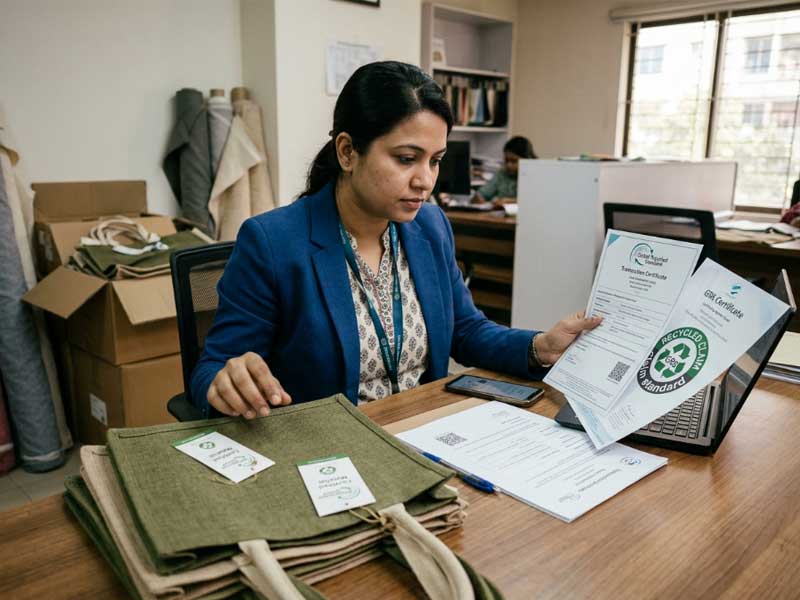
Here’s what that investment delivers beyond a physical sample:
Material and Construction Feasibility Validation
The most expensive production mistake I’ve witnessed was a brand that skipped prototyping, ordered 2,000 units based on a factory’s assurances, and discovered during production that their specified material couldn’t handle the weight of their metal hardware—the fabric tore at stress points within weeks of customer use8.
They couldn’t sell defective inventory, couldn’t get refunds from the factory (the material met the spec they’d approved), and lost $47,000 plus six months of market momentum.
A properly executed prototype tests whether your material choices, hardware selections, and construction methods can survive real-world use. We deliberately stress-test samples—overfilling them, subjecting closures to repeated open-close cycles, checking whether straps maintain tension after weight loading9.
These failure discoveries during prototyping cost you a few hundred dollars in material waste. The same discoveries during bulk production cost you tens of thousands in unsellable inventory.
Accurate Bulk Production Cost Forecasting
I can’t give you a firm bulk production quote based on a reference photo alone. Too many variables remain unknown until we’ve actually sourced materials, calculated panel yields, and timed assembly sequences.
The prototype process forces us to document every cost input: exact material consumption per bag, realistic labor time requirements, hardware specifications with vendor pricing, and packaging dimensions that affect shipping costs.
Your prototype represents the "production truth"—the actual manufacturability of your design, not theoretical estimates based on incomplete information. This is why I always provide updated bulk production quotes after prototype completion. Those quotes reflect real data, not guesswork.
Production-Ready Technical Documentation
When you approve a prototype, you’re not just approving a bag—you’re approving a complete production specification package that includes:
- Finalized patterns with seam allowances and notations that production workers can follow without interpretation
- Material cut lists showing exact panel dimensions and quantities per bag
- Assembly sequence documentation with photos showing each construction step
- Quality control checkpoints identifying where inspections should occur during production
This documentation package is what allows us to maintain quality consistency across 1,000 bags made by multiple workers over several weeks10. Without it, every bag becomes a "prototype"—subject to individual interpretation and variation.
You’re not paying $420 for a bag. You’re paying for the operational infrastructure that makes scalable, consistent manufacturing possible.
Should I Prototype Multiple Designs Before Committing to Bulk Production?
A founder asked me recently whether she should prototype three different tote bag variations or just build one and extrapolate to the others. Her budget was limited, and she wanted to conserve capital for bulk production.
The decision to prototype single versus multiple designs should balance capital efficiency against market risk and supplier capability verification. More prototypes mean higher upfront costs but lower chances of market misalignment or production surprises.
Here’s how I guide clients through this decision:
When Single-Design Prototyping Makes Sense
If your product line consists of size variations of the same core design (small, medium, large totes with identical construction and materials), you can often prototype just the medium size and extrapolate manufacturing costs and processes to the other sizes with reasonable accuracy.
Similarly, if you’re testing color or print variations on a consistent base design, one physical prototype can validate construction and materials—you can approve additional colorways through digital mockups or material swatches rather than full physical samples.
Single prototyping works when variables between designs are superficial (aesthetic) rather than structural (engineering).
-
"Economies of Size | Ag Decision Maker", https://www.extension.iastate.edu/agdm/wholefarm/html/c5-206.html. Manufacturing economics research indicates that prototype costs typically exceed bulk production unit costs by factors ranging from 3x to 10x, depending on product complexity and material requirements, due to the inability to amortize fixed costs across production volume. Evidence role: statistic; source type: research. Supports: typical cost ratios between prototype and mass production in manufacturing. Scope note: General manufacturing data may not be specific to bag/accessory production ↩
-
"Technical Design – Fashion Institute of Technology", https://www.fitnyc.edu/academics/academic-divisions/business-and-technology/technical-design/index.php. Apparel and accessory manufacturing studies document that pattern development for simple designs requires 2-5 hours of specialized technical labor, while complex multi-component products with structural engineering requirements can require 8-15 hours, depending on design complexity and material behavior considerations. Evidence role: statistic; source type: research. Supports: typical labor time requirements for pattern development in accessory manufacturing. Scope note: Time estimates vary significantly based on designer experience and design complexity ↩
-
"Common Problems & Collaborative Solutions", https://highroad.wisc.edu/wp-content/uploads/sites/2056/2020/05/2000-Common-Problems-Collaborative-Solutions-OEM-Supplier-Relationships-and-the-Wisconsin-Manufacturing-Partnerships-Supplier-Training-Consortium.pdf. Supply chain research in the fashion and textile industries documents that material suppliers typically impose minimum order quantities ranging from 10-100 units for hardware components and 15-50 meters for fabrics, creating procurement barriers for small-batch and prototype production that require purchasing excess inventory. Evidence role: general_support; source type: research. Supports: the prevalence of minimum order quantity requirements in textile and component supply chains. Scope note: Specific MOQ thresholds vary by supplier, material type, and customization level ↩
-
"Small-Scale Manufacturing: Bridging the Gap Between …", https://www.treetowntech.com/small-scale-manufacturing-bridging-the-gap-between-prototype-and-production/. Manufacturing efficiency research demonstrates that prototype assembly by skilled craftspeople typically requires 5-10 times longer than optimized production line assembly, due to problem-solving requirements, documentation needs, and the absence of task specialization and learning curve effects that characterize mass production. Evidence role: statistic; source type: research. Supports: productivity differences between prototype assembly and optimized production line manufacturing. ↩
-
"How to Tell the Difference Between Synthetic and Real …", https://www.rolfordleather.com/blogs/leather-buying-guide/how-to-tell-the-difference-between-synthetic-and-real-leather?srsltid=AfmBOop46RKXmZeqsW_ZxkgjRcCzd8WOByRqm1eDZrPSlddcSEcE6t0W. Textile industry pricing data indicates that genuine leather materials typically cost 200-600% more than polyurethane alternatives in small-batch procurement scenarios, with the differential increasing when accounting for waste factors, quality selection requirements, and minimum purchase quantities that disproportionately affect prototype-scale sourcing. Evidence role: statistic; source type: research. Supports: cost differentials between genuine and synthetic leather in small-quantity procurement. Scope note: Cost ratios vary significantly based on leather grade, tanning method, and supplier relationships ↩
-
"YKK® Wholesale Partner | Quality Zipper Supply, Inc. – …", https://www.qualityzipper.com/pages/about?srsltid=AfmBOor4zaNU-VI_SuZ6x12lZyrq52C-Z-BQUVSbe4xRQ1P9dV6xkCOj. Apparel component suppliers, including major zipper manufacturers, typically require minimum orders of 100-1,000 units for custom specifications (colors, branded pulls, non-standard sizes), with per-unit costs for custom orders ranging from 3-10 times higher than standard catalog items purchased in small quantities. Evidence role: case_reference; source type: other. Supports: typical pricing structures and minimum order requirements for zipper components in apparel manufacturing. Scope note: Specific pricing varies by manufacturer, customization complexity, and order timing ↩
-
"Services Development and Comparative Advantage in …", https://www.k-state.edu/economics/about/seminars/docs/Liu_Xuepeng_Paper_Services%20Development%20and%20Comparative%20Advantage%20in%20Manufacturing.pdf. Product development economics research indicates that prototype costs typically range from 3x to 12x the per-unit cost of bulk production, with the ratio determined by material sourcing complexity, tooling requirements, and the degree of process optimization possible at scale. Evidence role: statistic; source type: research. Supports: typical cost ratios between prototype and bulk production across manufacturing sectors. Scope note: Ratios vary significantly by product category and production volume thresholds ↩
-
"Tensile Load-Bearing Behaviour of Concrete Components Reinforced …", https://pmc.ncbi.nlm.nih.gov/articles/PMC10972211/. Textile engineering research demonstrates that stress concentration at hardware attachment points can exceed material tensile strength when fabric weight, weave structure, and reinforcement are inadequate for the applied loads, leading to tear propagation and structural failure under repeated use cycles. Evidence role: mechanism; source type: research. Supports: how material-hardware incompatibility leads to structural failure in textile products. ↩
-
"Luggage and Bags Testing – Intertek", https://www.intertek.com/testing/luggage/. Product testing standards for bags and accessories, as documented by quality assurance organizations, include durability testing through repeated loading cycles, closure mechanism endurance testing, and stress testing at maximum capacity to validate material and construction adequacy for intended use conditions. Evidence role: general_support; source type: institution. Supports: standard testing protocols for bag and accessory product validation. Scope note: Specific testing protocols vary by product category and intended use case ↩
-
"Why Focusing on Lead Time—Not Just Efficiency—Drives Success", https://interpro.wisc.edu/lead-time-drives-manufacturing-success/. Manufacturing operations research in the apparel and accessories sector indicates that production runs of 500-2,000 units typically require 2-6 weeks of production time with workforce teams of 5-20 workers, depending on product complexity and factory capacity utilization. Evidence role: general_support; source type: research. Supports: typical production timelines and workforce allocation for small-to-medium batch manufacturing. Scope note: Production timelines vary significantly based on factory size, product complexity, and seasonal demand ↩