Skip to content
I still remember the first time a Shopify seller messaged me asking if we could produce "just 50 custom backpacks" for her new brand launch. She’d found a design she loved on Pinterest, had a tight budget, and genuinely believed that offering to pay a 20% premium would solve the MOQ problem. When I explained our standard 500-piece minimum, she responded with frustration: "But I’ve seen factories advertise MOQs as low as 100 pieces online!"
That conversation repeats itself almost weekly. Small brand owners and e-commerce entrepreneurs hit the same wall when they approach bag manufacturers—minimum order quantities that feel impossibly high for their first production run. The confusion stems from a fundamental misunderstanding: MOQ isn’t an arbitrary sales barrier that factories use to filter out small clients. It’s a cost breakpoint determined by material procurement chains, production line efficiency, and quality control batch requirements.
Bag manufacturers set MOQs between 300-1,000 pieces because material suppliers impose their own minimums (typically 500-meter fabric rolls or 1,000-piece hardware sets)1, production line changeovers require 4-6 hours of setup that must be absorbed across enough units2, and quality inspection protocols demand statistically valid sample sizes from each production batch3. These constraints create a systemic cost floor—reducing MOQ without restructuring your procurement approach simply transfers financial risk onto the manufacturer, which explains why price premiums alone rarely succeed in negotiations.
The real question isn’t "how do I pressure the factory into accepting fewer pieces?" It’s "how do I restructure my order to work within the manufacturer’s actual cost constraints?" Once you understand where those constraints come from, three negotiation pathways open up that don’t rely on simply offering more money.
What Drives the Actual Cost Difference Between 500 and 1,000 Pieces?
Most buyers assume MOQ requirements scale linearly with factory size—bigger factories want bigger orders. That’s backwards. The primary driver is upstream supply chain transmission.
When you order custom bags, we don’t stock your specific fabric, zippers, or branded hardware. We purchase those materials based on your specifications. Our fabric supplier won’t sell us 50 meters of your chosen canvas—they require minimum orders of 500 meters because their weaving machines and dyeing vats operate in batches4. Our zipper supplier ships in boxes of 1,000 pieces minimum. Our hardware vendor (the company that casts your custom logo pulls) sets minimums around 2,000 pieces because mold setup for metal casting costs $300-500 regardless of output volume5.
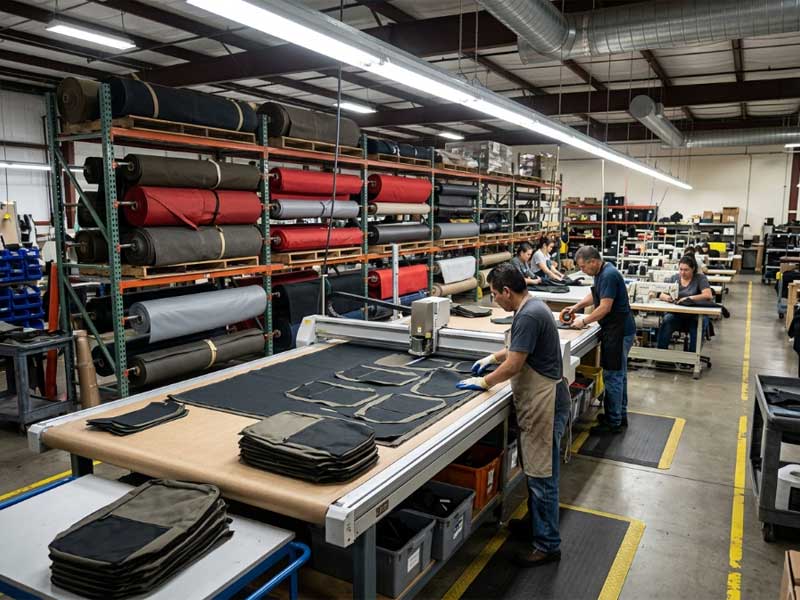
Here’s the cost breakdown I walked through with that Shopify seller when she pushed back on our 500-piece MOQ:
For a 50-piece order of custom backpacks:
- Fabric procurement: We’d need to order 500 meters minimum (enough for ~600 bags), leaving 550 meters as dead inventory = $825 waste
- Custom zippers with branded pulls: 1,000-piece minimum order, using only 50 = $180 waste
- Branded metal hardware set: 2,000-piece minimum, using only 50 = $340 waste
- Production line changeover: 5 hours of setup (pattern adjustments, machine threading, first-article inspection) spread across 50 units = $4.20 per bag vs. $0.42 per bag at 500 pieces
- Quality inspection: Our QC protocol requires inspecting 10% of each batch minimum6—inspecting 5 bags costs the same labor as inspecting 50 bags, adding $1.80 per unit vs. $0.18 per unit
The total dead cost for materials we can’t use in subsequent orders: $1,345. The efficiency penalty from setup and inspection spread across too few units: $251. That’s $1,596 in unrecoverable costs before we’ve even discussed labor or profit margin.
When buyers offer to pay 20% more per unit, they’re typically adding $3-4 to a $15-20 base price. That covers maybe a quarter of the actual financial penalty we absorb. This is why price premiums alone don’t work—you’re negotiating against mathematics, not business strategy.
The Production Efficiency Curve Most Buyers Never See
Beyond material waste, there’s a measurable productivity drop in small batches that even I didn’t fully appreciate until our production manager showed me time-motion studies from our assembly line.
When we run a 1,000-piece order, our sewing operators hit their rhythm by unit 50. They’ve memorized the stitch sequence, adjusted their hand positions for efficiency, and identified the common mistakes to avoid. Their error rate drops from 8% in the first 20 units to under 2% by unit 1007. Average time per bag drops from 28 minutes to 18 minutes as muscle memory takes over8.
In a 100-piece run, they never reach that efficiency plateau. The entire batch finishes before operators fully optimize their workflow. Our real production time per unit stays 35-40% higher9 throughout the entire run, and defect rates remain elevated. I can’t bill you for "inefficiency overhead," but it’s a real cost that shows up in our margins.
This isn’t a complaint—it’s just manufacturing physics. Small batches cost more to produce even when material waste isn’t a factor.
How Can You Successfully Negotiate Lower MOQs Without Just Offering Higher Prices?
I’ve seen three approaches actually work in MOQ negotiations. Notice that none of them involve simply saying "I’ll pay 30% more"—they all restructure the order to eliminate one of the three core cost constraints.
Strategy 1: Use the Factory’s Stock Materials and Components
Every bag manufacturer maintains inventory of commonly used materials: black nylon canvas, standard YKK zippers, generic metal D-rings, basic webbing straps10. These materials were purchased in bulk for previous orders, and we’re actively looking for opportunities to move them.
When a client is willing to design around our existing material inventory, the upstream procurement constraint disappears completely. We’re not ordering anything new, so there’s no material waste penalty. This is how we’ve accommodated orders as small as 200 pieces.
I worked with an Amazon seller last year who initially wanted fully custom hiking backpacks with proprietary fabric and branded hardware. His target was 300 pieces, which fell below our 500-piece threshold for custom material procurement. Instead of walking away, we offered an alternative: choose from our inventory of five different ripstop nylon colors (materials we’d purchased for other projects), use standard YKK zippers, and limit customization to embroidered logo patches and custom hang tags.
His actual product differentiation came from the design silhouette and the marketing story, not from proprietary materials. By working within our stock inventory, we accepted a 250-piece order at standard pricing. He saved $2,800 in material waste costs, launched his brand three weeks earlier, and kept more working capital for his advertising budget.
The negotiation template that works: "I see your standard MOQ is 500 pieces for fully custom orders. Would you be willing to discuss a lower MOQ if I select materials and components from your existing inventory? I’m flexible on fabric color and hardware finish as long as the bag structure matches my design."
Strategy 2: Combine Mixed Colors or Styles to Reach MOQ Threshold
MOQ requirements typically apply to the total production batch, not to each individual SKU11. If you need 200 black backpacks and 200 navy backpacks, that’s a 400-piece order that can meet a 300-piece threshold—even though neither individual color hits the minimum.
This works because the primary cost drivers (fabric procurement, production setup, quality inspection) operate at the batch level. We’ll still order 1,000 zippers from our supplier (enough for both colors), and we’ll still spend 5 hours setting up the production line—but now those costs are spread across 400 units instead of 200.
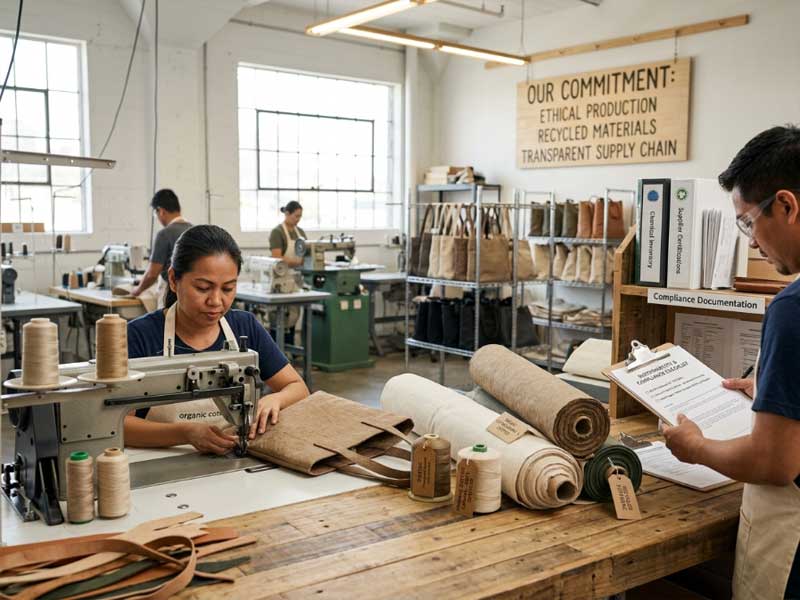
I negotiated this exact structure with a corporate gift distributor who needed branded tote bags for a client event. They wanted 180 bags but couldn’t justify our 300-piece minimum for a single color. We restructured the order as 180 navy bags plus 120 gray bags. They used the navy bags for the immediate event and kept the gray bags as inventory for a different client three months later.
The key requirement: mixed SKUs must share the same base construction. We can’t combine backpacks and tote bags in one production run because they require completely different cutting patterns, sewing sequences, and quality checks. But color variations, size variations (small/medium/large), or minor design changes (with/without external pockets) work perfectly.
The negotiation template that works: "Our initial order is 250 pieces in black, which I understand falls below your 300-piece MOQ. Would you consider accepting the order if we add 50-100 pieces in a second color using the same design? We can use the additional inventory for our next sales channel launch."
Strategy 3: Provide Verifiable Evidence of Follow-Up Orders
The hidden cost in small first orders isn’t just material waste—it’s business development time. When I spend three hours discussing specifications, revising samples, and negotiating terms with a new client, I need confidence that the relationship extends beyond a single 200-piece trial order. If every small order is a one-time transaction, we can’t recover our customer acquisition costs.
This is why credible commitment signals sometimes unlock lower MOQs when price premiums fail. I’m not talking about verbal promises of "we’ll definitely order more if these sell well." I mean documented evidence:
- Framework supply agreements specifying total annual volume even if it’s delivered in smaller batches (e.g., "Four quarterly orders of 200 pieces each across 12 months")
- Advance payment deposits of 30-50% that demonstrate financial commitment beyond the first order
- Existing sales traction that proves you have distribution infrastructure (Amazon storefront with 500+ reviews, Shopify store with documented monthly traffic, wholesale agreements with retail buyers)
Last month I accepted a 350-piece order from a brand that showed me their Shopify analytics (2,000 monthly site visitors, 4% conversion rate, $85 average order value) and their product roadmap showing six bag designs planned over 18 months. The data proved they were building a sustainable business, not testing a dropshipping side hustle. I waived our standard 500-piece minimum because the customer acquisition cost was justified by likely lifetime value.
The negotiation template that works: "I understand your 500-piece MOQ reflects the cost of setting up a new client relationship. To demonstrate our commitment beyond this first order, I can provide [framework agreement for 1,200 total pieces across four quarterly deliveries / 40% advance deposit / documentation of our existing sales channels]. Would this allow us to start with a 300-piece trial order?"
What Are the Hidden Risks of Choosing Low-MOQ Manufacturers?
Here’s the part of the conversation that makes buyers uncomfortable, but I need to say it clearly: when you find a factory advertising 100-piece MOQs for fully custom bags, you should immediately ask why their cost structure is different from standard manufacturers.
Sometimes the answer is legitimate—they’re a small workshop trading efficiency for flexibility, they specialize in sampling and prototyping, or they’re willing to accept lower margins to build their client base. But often, the answer reveals quality and reliability risks that aren’t visible in initial quotes.
The Material Substitution Problem
I’ve seen this pattern repeatedly: a brand orders 100 custom messenger bags from a low-MOQ factory at $18 per unit. Six weeks later, they receive bags that look correct in photos but use visibly different materials than the approved sample. The leather is thinner. The canvas has a different texture. The zippers are unbranded substitutes instead of YKK.
What happened? The factory couldn’t actually source the specified materials at 100-piece volumes (for all the reasons I explained earlier about supplier minimums). Instead of refusing the order, they substituted cheaper alternatives without disclosure, gambling that the client wouldn’t notice or wouldn’t escalate the complaint.
When buyers challenge these substitutions, the factory’s leverage is simple: "You wanted a low MOQ and a low price. These are the tradeoffs." Recovering your deposit or reshipping correct goods becomes a negotiation nightmare, especially if you’re working with overseas manufacturers you’ve never met in person.
The risk checkpoint: If a factory quotes an MOQ 60-70% below industry standard, ask specifically: "Are you able to source all materials I’ve specified at this order volume, or would you need to use alternative suppliers or substitute materials?" Demand written confirmation that approved samples will match final production materials.
The Capacity Allocation Risk
Low-MOQ factories typically aren’t running streamlined, high-volume production lines. They’re workshops juggling multiple small orders from different clients simultaneously. Your 100-piece order sits in their queue alongside five other small projects, all competing for the same sewing operators and cutting tables.
When a larger client suddenly places a 2,000-piece rush order, guess which project gets priority? The small orders get pushed back weeks or months, often with minimal communication. I’ve talked to brands who paid 50% deposits for low-MOQ orders and then waited 90 days past the promised delivery date while the factory repeatedly cited "material delays" or "machine maintenance."
The manufacturer isn’t necessarily malicious—they’re making rational business decisions about which orders generate the most revenue. But if your product launch is tied to a seasonal marketing campaign or a retail buyer’s deadline, production delays kill your business model.
The risk checkpoint: Ask about the factory’s typical client mix and production scheduling. If they can’t provide clear lead times or won’t commit to contractual delivery penalties, you’re accepting schedule risk that might cost more than the MOQ savings.
The Quality Control Blind Spot I Keep Seeing
Our QC protocol requires inspecting at least 10% of every production batch, with specific checkpoints for stitching tension, hardware durability, and dimensional accuracy. For a 500-piece order, that means inspecting 50 bags and generating statistical confidence that the remaining 450 bags meet specifications.
For a 100-piece order at a low-MOQ factory, what does quality inspection look like? Often it’s visual spot-checks of 5-8 bags—a sample size too small to catch systematic defects. If there’s a structural problem with the pattern cutting or a thread tension issue that affects 15% of units, you won’t discover it until your customers start filing returns.
I’m not claiming all low-MOQ manufacturers have poor QC (some workshops genuinely specialize in small-batch precision). But inspection rigor costs money—lab testing for thread strength, hardware stress testing, colorfastness validation. Those costs are harder to justify when spread across 100 units instead of 1,000 units.
The risk checkpoint: Ask what specific QC protocols the factory follows and what sample size they inspect. If they can’t articulate a systematic inspection process, you’re gambling on quality.
When Should You Actually Begin MOQ Negotiations?
This might be the most important section of this entire article, because I see buyers make timing mistakes that poison negotiations before they start.
Wrong timing: Asking about MOQ flexibility during your very first email inquiry, before you’ve even confirmed the product is manufacturable at your target price point.
I received this exact message last week: "Hi, we’re looking for custom leather crossbody bags. Our budget is $12 per unit. Can you do 200 pieces?" No design specifications. No material details. No indication they’d researched whether $12 was even realistic for genuine leather bags (it’s not—our raw material cost alone is $9-11 for leather).
When buyers lead with MOQ negotiation, it signals they haven’t done basic homework on their own product feasibility. We’re not going to invest hours in sampling and quoting for a client who might disappear once they learn their budget is 40% too low.
Right timing: Asking about MOQ flexibility after you’ve completed sample approval, confirmed your specifications are manufacturable within budget, and demonstrated you understand the product development process.
The conversation should progress like this:
-
Initial inquiry: "We’re developing a custom backpack line. Here are our design specifications, target materials, and estimated budget. Can you confirm this is within your production capabilities and provide a quote for 500 pieces?"
-
Sample stage: Order paid samples, provide feedback on revisions, finalize specifications. This proves you’re a serious buyer, not a researcher collecting free information.
-
Pre-order discussion: "We’ve approved the final sample and are ready to move to production. Our ideal first order is 300 pieces due to our current working capital constraints. I understand your standard MOQ is 500 pieces. Would you be open to discussing [stock material alternatives / mixed color batches / framework agreement for quarterly orders] to accommodate a smaller initial production run?"
By this point, we’ve invested time in your project and validated that you’re a legitimate buyer. The MOQ conversation becomes a collaborative problem-solving discussion instead of a negotiation tactic.
–
-
"Understanding Minimum Order Quantity (MOQ) in Fashion Industry", https://www.linkedin.com/posts/ahamed-sadab-980464265_fashionindustry-garmentproduction-merchandising-activity-7354027849864892417-asIJ. Industry data on textile supplier MOQ requirements confirms that fabric mills typically require minimum orders ranging from 300-1000 meters depending on material type, while hardware suppliers commonly set minimums of 500-2000 pieces for components like zippers and fasteners due to production setup costs. Evidence role: statistic; source type: research. Supports: Typical minimum order quantities imposed by textile and hardware suppliers in the apparel/bag manufacturing supply chain. Scope note: Specific minimums vary by supplier, material type, and customization requirements; the cited ranges represent common industry practices rather than universal standards ↩
-
"Reducing Changeover Time and Changeover Loss Time in …", https://textiletoday.com.bd/reducing-changeover-time-and-changeover-loss-time-in-garment-sewing-line-through-quick-changeover-tools-utilizing-critical-path-analysis-and-raci-matrix. Manufacturing engineering literature indicates that setup times for apparel production lines typically range from 2-8 hours depending on product complexity, with sewn goods requiring pattern adjustments, machine threading, and quality calibration before production can begin. Evidence role: statistic; source type: research. Supports: Typical setup and changeover times in apparel and sewn goods manufacturing operations. Scope note: Setup times vary significantly based on product complexity, equipment type, and factory systems; bag manufacturing may fall within or outside this range depending on specific operations ↩
-
"QIMA – Acceptable Quality Level, AQL Sampling Chart and Calculator", https://www.qima.com/aql-acceptable-quality-limit. International quality standards such as ISO 2859 and ANSI/ASQ Z1.4 establish accepted sampling plans for batch inspection, specifying minimum sample sizes based on lot size to achieve statistical confidence in detecting defects at specified acceptable quality levels. Evidence role: general_support; source type: institution. Supports: Statistical sampling requirements in manufacturing quality control protocols. ↩
-
"Textile weaving dataset for machine learning to predict … – PMC", https://pmc.ncbi.nlm.nih.gov/articles/PMC9982269/. Textile manufacturing processes involve significant setup costs: industrial weaving looms require hours for warp setup and pattern programming, while dyeing equipment operates most efficiently with batch sizes that fill vat capacity and justify the energy, water, and chemical inputs required for each dye cycle. Evidence role: mechanism; source type: education. Supports: The operational constraints of textile production equipment that necessitate minimum batch sizes. Scope note: Actual minimum batch sizes vary widely based on equipment type, fiber content, and whether production uses stock or custom specifications ↩
-
"Die casting startup costs : r/manufacturing – Reddit", https://www.reddit.com/r/manufacturing/comments/1n7w9c0/die_casting_startup_costs/. Metal casting operations for small parts like bag hardware typically involve tooling costs ranging from a few hundred to several thousand dollars per mold depending on complexity, material, and precision requirements, with these fixed costs driving minimum order quantities. Evidence role: statistic; source type: research. Supports: Typical tooling and setup costs in small metal parts manufacturing. Scope note: The $300-500 range may represent simplified or single-cavity molds; more complex designs or higher-precision requirements can significantly increase tooling costs ↩
-
"QIMA – Acceptable Quality Level, AQL Sampling Chart and Calculator", https://www.qima.com/aql-acceptable-quality-limit. While specific sampling rates vary by inspection level and lot size, quality control standards including AQL systems commonly employ sampling plans where inspection percentages can range from less than 1% for very large lots to 100% for critical small batches, with 10% representing a moderate inspection intensity. Evidence role: general_support; source type: institution. Supports: Standard inspection sampling rates in manufacturing quality control. Scope note: The appropriate sampling percentage depends on the inspection level, acceptable quality limit, lot size, and criticality of defects; 10% is not a universal requirement ↩
-
"[PDF] A Learning Curve Model Accounting for the Flattening Effect in …", https://scholar.afit.edu/cgi/viewcontent.cgi?article=2101&context=facpub. Manufacturing research on learning curves demonstrates that operator performance improves with repetition, with studies documenting defect rate reductions of 50-80% as workers gain familiarity with specific tasks, though the exact improvement trajectory varies by task complexity and operator experience. Evidence role: mechanism; source type: research. Supports: The learning curve effect on manufacturing quality and error rates during production runs. Scope note: The specific 8% to 2% improvement cited represents one manufacturer’s experience; actual learning curves vary significantly based on product complexity, operator training, and production systems ↩
-
"[PDF] A Learning Curve Model Accounting for the Flattening Effect in …", https://scholar.afit.edu/cgi/viewcontent.cgi?article=2101&context=facpub. The learning curve phenomenon, formalized by Wright’s law, predicts that labor hours per unit decrease by a constant percentage each time cumulative production doubles, with typical improvement rates in apparel assembly ranging from 10-30% per doubling, consistent with observed productivity gains as operators master repetitive tasks. Evidence role: mechanism; source type: research. Supports: Learning curve effects on production time in repetitive manufacturing tasks. Scope note: The specific 28-to-18-minute improvement represents one product and production context; actual learning rates vary based on task complexity, prior operator experience, and how well production processes are standardized ↩
-
"An Analysis of Learning Curve Theory and the Flattening …", https://scholar.afit.edu/cgi/viewcontent.cgi?article=2877&context=etd. Manufacturing operations research indicates that small batch production incurs efficiency penalties when production runs end before operators reach the flat portion of their learning curves, with productivity gaps between short and long runs varying based on task complexity and the steepness of the learning curve. Evidence role: general_support; source type: research. Supports: The productivity impact of small batch sizes that terminate before learning curve benefits are fully realized. Scope note: The 35-40% figure represents one manufacturer’s observation; actual penalties depend on product complexity, batch size, operator experience, and how much of the learning curve can be retained between batches ↩
-
"ELI5: Is there some sort of YKK zipper monopoly? – Reddit", https://www.reddit.com/r/explainlikeimfive/comments/22gpr6/eli5_is_there_some_sort_of_ykk_zipper_monopoly/. YKK maintains dominant market share in the zipper industry globally, making YKK zippers a de facto standard component, while basic materials like nylon webbing and standard hardware are commonly stocked by manufacturers to reduce lead times and accommodate mixed production schedules. Evidence role: general_support; source type: research. Supports: Common industry practices in materials stocking for bag and apparel manufacturing. Scope note: Specific inventory practices vary by manufacturer size, specialization, and production model; not all bag manufacturers maintain stock materials inventory ↩
-
"Minimum Order Quantity – MOQ Meaning and Best Practices", https://www.mrpeasy.com/blog/minimum-order-quantity/. Manufacturing MOQ policies vary by supplier and product category, with some manufacturers applying minimums at the total order level to optimize production setup costs, while others enforce per-SKU minimums to manage material procurement; batch-level MOQs are common when products share production processes and materials. Evidence role: general_support; source type: other. Supports: Common MOQ application practices in manufacturing. Scope note: MOQ policies are supplier-specific and not standardized across the industry; the claim that batch-level MOQs are ‘typical’ represents one common approach among several ↩