Skip to content
Every week, we receive Tech Packs that look complete on the surface—beautiful sketches, detailed descriptions, mood boards. But when our pattern-makers and material procurement team sit down to translate these documents into actual production instructions, we hit the same wall: missing technical specifications that force us to guess what you actually need. Those guesses turn into sampling mismatches, revision loops, and frustrated emails where both sides wonder why "simple communication" became so complicated1.
A Tech Pack is not a product catalog description for retail customers. It is a production instruction set that must answer every question our factory will ask during material sourcing, hardware procurement, pattern-making, and assembly sequencing. When critical specifications are missing or ambiguous, we cannot proceed with sampling—we must pause and email you a list of clarification questions. This back-and-forth typically adds 1–2 weeks before we even cut the first pattern piece2. The revised samples that follow usually require 1.5 rounds of adjustments on average3, extending your total lead time by 3–4 weeks. Most clients perceive these delays as factory inefficiency, but the root cause is almost always incomplete technical preparation on the submission side.
Here’s the reality from our production floor: incomplete Tech Packs don’t save you time by letting the factory "figure out the details"—they guarantee slower sampling, higher costs, and structural compromises you didn’t authorize. This guide walks through what we actually need to see in your Tech Pack before we can give you an accurate quote and realistic timeline.
What Information Must a Tech Pack Include for Accurate Sampling?
When we open a new Tech Pack submission, our team follows a fixed evaluation sequence: Can we source these exact materials? Can we procure this hardware to specification? Can our pattern-makers draft these dimensions without structural conflicts? Can our assembly line execute this construction sequence? If any section forces us to guess, we stop and send clarification requests.
Your Tech Pack must provide complete, unambiguous instructions for material procurement, hardware specifications, structural dimensions, and construction methods. Vague language like "high-quality leather" or "multiple pockets" does not give us enough information to start production preparation. We need thickness measurements, finishing standards, exact pocket counts with placement coordinates, and closure mechanism details.
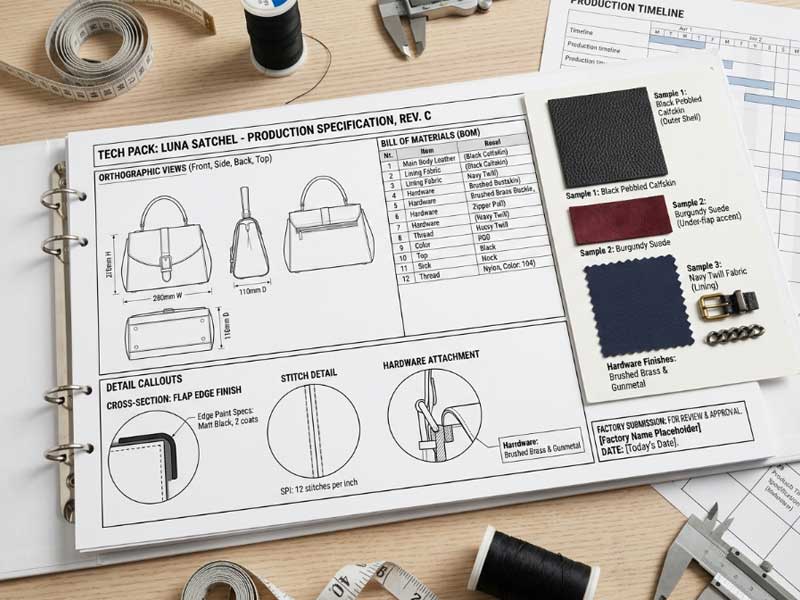
Material Specifications: Beyond Retail Descriptions
When a Tech Pack lists materials as "genuine leather" or "premium canvas," we face an immediate problem. These are marketing terms that describe perceived quality to retail buyers, but they don’t tell our procurement team which supplier catalog to search, what thickness range to request, or what finishing process creates the texture you’re envisioning.
Material specifications must include:
- Exact material type and grade – Not "genuine leather," but "full-grain cowhide4" or "top-grain lambskin." Not "canvas," but "16oz cotton canvas" or "600D polyester."
- Thickness measurements in millimeters – 0.8mm leather drapes differently than 1.2mm leather. This affects everything from pattern allowances to stitching needle selection.
- Finishing and treatment standards – Drum-dyed vs. spray-dyed. Matte vs. semi-gloss. Wax finish vs. oil finish. Water-resistant coating specifications.
- Physical flexibility and hand feel – Soft temper vs. firm temper. This determines structural integrity and how the bag holds its shape.
- Color matching standards – Pantone codes5, physical swatches, or tolerance ranges (±5% variance acceptable vs. exact match required).
When you submit "lychee grain leather," we don’t know if you mean:
- Natural full-grain leather with natural texture
- Embossed top-grain leather mimicking lychee pattern
- PU synthetic with lychee grain surface texture
These three options have completely different price points (ranging from $8/yard to $45/yard6), different durability characteristics, and different production compatibility. We cannot guess which one aligns with your quality expectations and budget constraints.
Instead of generic descriptions, provide: "Full-grain cowhide, 1.0–1.2mm thickness, drum-dyed, matte finish, soft temper comparable to attached physical swatch, color Pantone 18-1239 TPG." This gives our procurement team exact search parameters and eliminates interpretation guesswork.
Hardware and Component Specifications
Reference images of zippers, buckles, D-rings, and magnetic snaps show us the aesthetic you want, but they don’t tell us the technical specifications our hardware suppliers need. When we receive only photos without dimensions or performance standards, we’re forced to substitute "visually similar" components that may not meet your durability expectations or quality thresholds.
Hardware specifications must include:
| Component Type | Required Specifications |
|---|---|
| Zippers | Width (3#, 5#, 8#), teeth material (metal/resin/coil), tape color, stopper type, puller style with dimensions, YKK equivalent grade or comparable standard |
| Buckles & D-rings | Inner width measurement (mm), metal type (zinc alloy/brass/stainless), plating finish (nickel/antique brass/gun metal), weight capacity rating |
| Magnetic snaps | Diameter (14mm/18mm/25mm), magnetic pull strength (light/medium/heavy), prong vs. screw-back attachment, plating specification |
| Rivets & studs | Cap diameter, post length, material and plating, double-cap vs. single-cap, load-bearing vs. decorative |
| Buckle hardware | Pin length, frame width, roller vs. fixed bar, adjustment hole spacing if applicable |
When you send us a photo of a zipper with the note "use this style," we see a zipper that could be:
- A #5 metal teeth zipper with antique brass finish ($1.20/unit)
- A #5 resin teeth zipper with brass-colored tape ($0.45/unit)
- A #8 metal teeth zipper with real brass plating ($2.80/unit)
These aren’t interchangeable substitutions—the weight, durability, and aesthetic finish create different product characteristics. The #8 metal zipper adds 40 grams to the bag weight7 and requires reinforced stress point stitching that the lighter options don’t need.
Instead of reference images alone, provide: "YKK #5 metal teeth zipper8, antique brass finish, 35cm length, closed-end with standard puller, tape color matching body fabric Pantone 19-4052." Our procurement team can source this exact component or propose verified equivalent alternatives with comparable specifications.
Interior Structure and Pocket Layout
"Multiple pockets" and "interior organization" are the most common sources of sampling revision loops. These phrases don’t tell our pattern-makers how many pockets you need, where to position them, what dimensions to cut, or which closure mechanisms to install. We’ve received Tech Packs that said "several interior pockets" and discovered during the revision phase that the client expected seven specific compartments in precise locations—information that would have added maybe 10 minutes to Tech Pack preparation but cost three weeks in sampling delays.
Interior structure specifications must include:
- Exact pocket count and types – Zip pockets, slip pockets, pen slots, key leash attachment points.
- Dimensional specifications – Width × height for each pocket opening, depth for gusset pockets.
- Placement coordinates – Distance from top edge, distance from side seams, centered vs. offset positioning.
- Closure mechanisms – Open-top, zip closure (specify zipper size), magnetic snap, Velcro, drawstring.
- Layer sequencing – Which pockets sit in front of others, attachment method (sewn into lining seam vs. topstitched onto lining face).
When we receive vague interior descriptions, we make educated guesses based on typical configurations for similar bag styles. But "typical" doesn’t mean "what you envisioned." We might place a phone pocket where you expected a tablet sleeve. We might create three equal-width compartments when you wanted one large section with two small side pockets.
Our team recommends providing interior specifications as a simple table:
| Pocket ID | Type | Dimensions (W × H × D) | Placement | Closure | Layer Position |
|---|---|---|---|---|---|
| A | Zip pocket | 180mm × 150mm × 30mm | Center back wall, 50mm from top | #5 zipper | Sewn into back lining seam |
| B | Slip pocket | 140mm × 160mm | Left wall, 60mm from top | Open top | Topstitched onto left lining |
| C | Key leash | — | Right wall, 80mm from top | Spring clasp | Riveted through lining |
This format takes maybe 15 minutes to complete, but it eliminates an entire revision cycle. Our pattern-makers can draft the interior structure correctly on the first attempt, and you receive a sample that matches your functional requirements without back-and-forth clarification emails.
How Do Dimension Specifications Prevent Structural Problems?
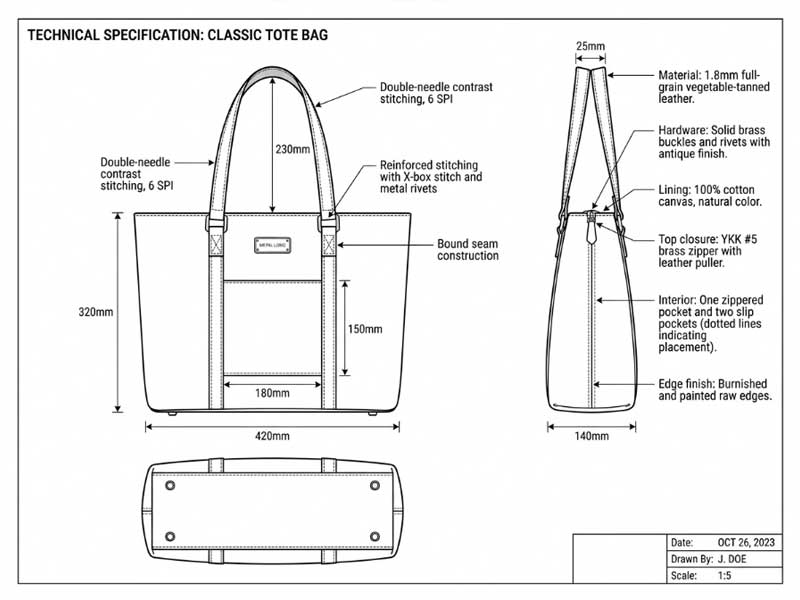
External dimensions seem straightforward—just measure the length, width, and height, right? But bags are three-dimensional structures that need to account for seam allowances, material thickness, gusset expansion, and stress point reinforcement. When Tech Packs provide only final exterior measurements without addressing these construction factors, we encounter situations where the specified dimensions create physical impossibilities.
Dimension specifications must separate aesthetic targets from technical construction requirements. Your Tech Pack should include final exterior dimensions, but also acknowledge that seam allowances, material stacking, and structural reinforcement will consume internal space. If you specify both exterior and interior dimensions without accounting for this material thickness layer, we cannot build what you’ve drawn.
Breaking Down Dimension Requirements
Our pattern-making team needs these measurements clearly separated:
Exterior dimensions:
- Overall length, width, height when bag is empty and sitting flat
- Handle drop length from top edge to handle peak
- Strap length end-to-end and width
- Base dimensions if different from body width/depth
Interior dimensions (critical for pocket planning):
- Usable interior space after accounting for 3–5mm material thickness on all walls
- Realistic compartment sizes that fit within this reduced interior volume
Construction allowances:
- Seam allowance standard you expect (10mm, 12mm, 15mm)
- Reinforcement layer requirements (single layer, double layer, interfacing)
- Edge binding or piping additions that add thickness
When you specify "interior pocket 200mm × 150mm" in a bag with 220mm interior width, you’ve created a problem: the pocket fabric edges need seam allowances (typically 10mm each side), the pocket attachment stitching takes another 3mm each side, and suddenly we need 226mm of space where only 220mm exists. Either the pocket won’t fit, or we have to reduce its size—which means the sample comes back "wrong" even though we followed your drawing exactly.
Instead, specify usable interior targets: "Interior should accommodate a pocket approximately 180mm × 140mm finished size, allowing for standard seam allowances and attachment stitching." This tells us your functional goal while acknowledging that construction details require adjustment space.
Dimension Conflicts We See Regularly
Several common specification combinations create physical impossibilities:
-
Specified interior volume exceeds exterior dimensions after accounting for material thickness – If your bag exterior is 300mm × 250mm × 100mm and uses 1.2mm leather with 10mm foam padding, the interior dimensions are approximately 275mm × 225mm × 75mm. Pockets specified at 290mm width won’t fit.
-
Handle attachment points conflict with interior pocket placement – You’ve specified handles attached 80mm from each side, and an interior zip pocket centered on the back wall. The handle rivets penetrate through both outer shell and lining, creating metal protrusions exactly where the pocket fabric needs to attach smoothly.
-
Zipper opening width insufficient for specified base depth – A 280mm zipper opening on a bag with 150mm base depth creates difficult access angles. Users can’t comfortably reach items at the bottom corners without awkward tilting.
We can identify these conflicts during Tech Pack review, but only if you provide complete dimensional information. When measurements are missing, we make assumptions that seem reasonable but might not match your design intent.
What Construction Details Affect Production Feasibility?
Some bag designs look elegant in sketches but present significant production challenges when we analyze the construction sequence. Certain seam configurations require specialized equipment. Some material combinations don’t bond reliably. Specific design elements create stress concentration points that lead to premature failure unless we add hidden reinforcement.
Construction method specifications should address stitching standards, seam types, edge finishing, reinforcement locations, and assembly sequencing. When these details are absent from the Tech Pack, we default to our standard production methods—which may not create the aesthetic finish or durability characteristics you’re targeting.
Stitching and Seam Specifications
Different stitching methods create different aesthetic appearances and structural strength:
- Lockstitch (standard)9 – Creates a balanced stitch on both sides, suitable for most seams, typically 5–7 stitches per inch for bags10.
- Double-needle stitching – Creates two parallel stitch lines, common for straps and reinforced seams, requires precise alignment.
- Saddle stitching (hand-sewn) – Creates a premium finish with angled thread appearance, significantly increases labor time and cost.
- Bartack reinforcement – Dense zigzag stitching at stress points (strap attachments, pocket corners), essential for durability.
- Edge stitching distance – How far from the edge to place decorative or functional stitching (typically 2mm, 3mm, or 5mm).
When your Tech Pack doesn’t specify stitching standards, we use our factory default: lockstitch at 6 stitches per inch with bartack reinforcement at stress points. If you expected visible contrast stitching at 3mm from all edges, or double-needle topstitching on straps, the sample will look different from your expectation—not because we made an error, but because you didn’t communicate this requirement.
Thread specifications also matter:
- Polyester vs. nylon thread (different strength and UV resistance)11
- Thread weight (#40, #60, #80—thicker thread creates more visible stitch lines)
- Thread color (match to fabric, contrast for design accent, or specific Pantone)
Edge Finishing Options
The edges of leather and fabric panels require finishing to prevent fraying and create a polished appearance:
| Finishing Method | Best For | Appearance | Cost Impact |
|---|---|---|---|
| Raw edge (no finishing) | Thick leather with burnished edges | Rustic, artisanal | Lowest |
| Edge paint | Full-grain and top-grain leather | Clean, uniform color edge | Low |
| Edge binding | Fabric, thin leather, or contrast accent | Visible binding strip | Medium |
| Piping | Premium finish, decorative accent | Raised cord wrapped in fabric/leather | Medium-high |
| Overlocked/serged | Interior fabric seams | Hidden inside, prevents fraying | Low |
Each method requires different production setup time and materials. Edge binding and piping particularly require advance preparation—we need to know the binding/piping material specifications, width, and whether you want matching or contrasting colors.
When Tech Packs show clean edge lines in the sketch without specifying the finishing method, we typically default to edge paint on leather and overlocked seams on fabric. If you expected contrast piping as a design accent, this represents a significant aesthetic difference that requires sample revision.
Hardware Attachment and Reinforcement
How hardware attaches to the bag body affects both appearance and durability:
- Rivets (double-cap or single-cap) – Visible on both sides or one side, creates permanent attachment, distributes stress.
- Screws (Chicago screws or sex bolts) – Allows hardware removal/replacement, requires thicker material or reinforcement plate.
- Sewn attachment – Strap loops sewn into seams, creates clean appearance but concentrates stress on stitching.
- Reinforcement patches – Hidden layers of leather or heavy fabric behind hardware attachment points, prevents tearing.
We add reinforcement patches at all major stress points by default (handle attachments, strap D-rings, bottom corners), but the size and material of these patches affects internal appearance. If your bag has a fabric lining and we add 40mm × 60mm leather reinforcement patches behind each handle attachment, these patches will be visible on the interior unless we specify otherwise.
Your Tech Pack should indicate: "Handle attachments require reinforcement patches, but patches must be concealed between outer shell and lining layers" or "Interior reinforcement patches acceptable and visible." This small clarification prevents interior finish surprises.
-
"3 mistakes I see fashion brands make in production After 12 … – Instagram", https://www.instagram.com/reel/DYf2KASSH_4/. Research on fashion supply chain management identifies specification ambiguity and incomplete technical documentation as contributing factors to production delays and iterative revision processes. Evidence role: general_support; source type: research. Supports: that communication gaps between designers and manufacturers contribute to production delays and revision cycles. Scope note: Studies may not quantify the specific 1-2 week delays mentioned, but support the general pattern of specification gaps causing production inefficiencies ↩
-
"Apparel Manufacturing Lead Times: A US Brand’s Guide", https://capitalworldgroup.com/apparel-manufacturing-lead-times/. Industry analyses of apparel product development cycles document that pre-production clarification phases can add significant time to sampling schedules when technical specifications are incomplete. Evidence role: statistic; source type: research. Supports: that specification clarification and iteration cycles extend production timelines in apparel manufacturing. Scope note: Published data may report ranges rather than the specific 1-2 week figure, which appears to be based on this factory’s experience ↩
-
"Apparel Manufacturing: NAICS 315 : U.S. Bureau of Labor Statistics", https://www.bls.gov/iag/tgs/iag315.htm. Studies of apparel product development processes report that sampling typically involves multiple revision cycles, with the number of iterations correlating to initial specification completeness. Evidence role: statistic; source type: research. Supports: that multiple sampling rounds are common in apparel manufacturing when initial specifications are incomplete. Scope note: The specific 1.5 rounds average appears to be factory-specific data rather than a published industry standard ↩
-
"Leather – Wikipedia", https://en.wikipedia.org/wiki/Leather. Full-grain leather represents the highest quality grade, retaining the complete grain surface without buffing or sanding, which distinguishes it from corrected-grain or split leather products. Evidence role: definition; source type: encyclopedia. Supports: the industry-standard definition and characteristics of full-grain leather as a material grade. ↩
-
"Pantone", https://en.wikipedia.org/wiki/Pantone. The Pantone Matching System serves as a widely adopted color standardization system that enables consistent color communication between designers and manufacturers through numerical color codes. Evidence role: definition; source type: encyclopedia. Supports: that the Pantone Matching System provides standardized color references used across design and manufacturing industries. ↩
-
"Buy Leather Fabric For Upholstery Online at Wholesale Prices", https://www.modern-fabrics.com/fabric-material-content/leather-fabrics-57.html?srsltid=AfmBOoqQQ9yvEkNxzGbXltvFiu_eZXxzH6e5orJ1-APK_sdUmmjtVIAs. Market analyses of leather pricing show substantial cost variation across material types and quality grades, reflecting differences in sourcing, processing, and finishing treatments. Evidence role: statistic; source type: research. Supports: that leather material costs vary significantly based on type, grade, and finishing. Scope note: Specific price points fluctuate with market conditions and supplier regions; the cited range illustrates the magnitude of variation rather than fixed pricing ↩
-
"Zipper Gauge Sizes Explained | Complete #5 #8 #10 Guide", https://lenzip.com/zipper-gauge-sizes-explained-the-complete-5-8-10-guide/. Zipper technical specifications indicate that size gauge and teeth material (metal versus coil or resin) significantly influence unit weight, with larger metal zippers weighing substantially more than smaller or non-metal alternatives. Evidence role: general_support; source type: research. Supports: that zipper size and material choices affect component weight in measurable ways. Scope note: The specific 40-gram figure appears to be context-dependent (zipper length and exact specifications) rather than a universal standard ↩
-
"Zipper Instruction Manual", https://ykkamericas.com/wp-content/uploads/2021/10/ykk-zipper-instruction-manual-compressed.pdf. YKK Corporation is the world’s largest zipper manufacturer, and its product coding system (including size designations like #3, #5, #8) has become a de facto industry reference standard for zipper specifications. Evidence role: general_support; source type: encyclopedia. Supports: that YKK is a dominant zipper manufacturer whose product specifications are widely used as reference standards. ↩
-
"Lockstitch", https://en.wikipedia.org/wiki/Lockstitch. Lockstitch is a stitch type in which two threads (needle and bobbin) interlock within the fabric layers, creating a balanced stitch appearance on both sides and serving as the most common stitch in industrial sewing applications. Evidence role: definition; source type: encyclopedia. Supports: the technical definition and mechanism of lockstitch as a fundamental sewing method. ↩
-
"How Many Stitches Per Inch for Leather – Fine Leatherworking", https://www.fineleatherworking.com/blog/how-many-stitches-per-inch-leather/?srsltid=AfmBOorhIF-nqTdT3B__7H9ejtHeERtKSA8zAmEBjqd-kiDk6V_oQG_5. Technical standards for leather goods manufacturing specify stitch density parameters that vary by application, with heavier materials typically requiring adjusted stitch counts for optimal seam strength and appearance. Evidence role: general_support; source type: research. Supports: typical stitch density ranges used in leather goods and bag manufacturing. Scope note: The specific 5-7 range may reflect common practice rather than a published standard, and optimal density varies with material thickness and product requirements ↩
-
"Evaluation of physical and mechanical characteristics of three-thread …", https://pmc.ncbi.nlm.nih.gov/articles/PMC10685180/. Textile engineering research documents that polyester and nylon threads have distinct material properties: polyester generally offers superior UV resistance and dimensional stability, while nylon provides higher tensile strength but greater susceptibility to UV degradation. Evidence role: general_support; source type: research. Supports: that polyester and nylon threads exhibit different performance characteristics including strength profiles and UV degradation resistance. ↩