Skip to content
In our 15 years manufacturing pet carriers for international brands and e-commerce sellers, I’ve watched buyers repeat the same evaluation mistakes—chasing surface-level specifications while missing the production details that determine whether a carrier survives real-world use or generates a flood of negative reviews.
Custom pet carrier manufacturing isn’t about finding the lowest quote—it’s about verifying supplier production credibility, identifying structural defect risks before mass production, and ensuring compliance claims match actual certification standards. Most buyers who focus exclusively on unit price and aesthetic similarity to popular designs end up with defective inventory, compliance gaps that block sales channels, and return rates that erase profit margins1.
Here’s the real problem: the pet carrier market rewards suppliers who can present convincing MOQ terms and quick turnaround promises, not necessarily those with proven production expertise. As a manufacturer who’s witnessed clients learn these lessons the expensive way, I’m documenting what you should verify during supplier evaluation—the production questions that separate experienced factories from trading company intermediaries, the compliance details that determine whether "airline-approved" claims are legitimate, and the structural design elements that prevent the most common field failures.
What Makes a Reliable Pet Carrier Manufacturer?
Supplier selection for custom pet carriers feels overwhelming because surface credentials don’t correlate with production capability—a factory with impressive certifications might still lack experience with the specific structural challenges of pet carrier design, while a smaller operation could have deep expertise in ventilation engineering and stress reinforcement that larger facilities miss.
A reliable pet carrier manufacturer demonstrates production expertise through specific manufacturing observations, maintains transparent communication about material trade-offs and design limitations, and provides verifiable compliance documentation rather than vague certification claims. The qualification process requires asking technical questions that only hands-on production experience can answer.
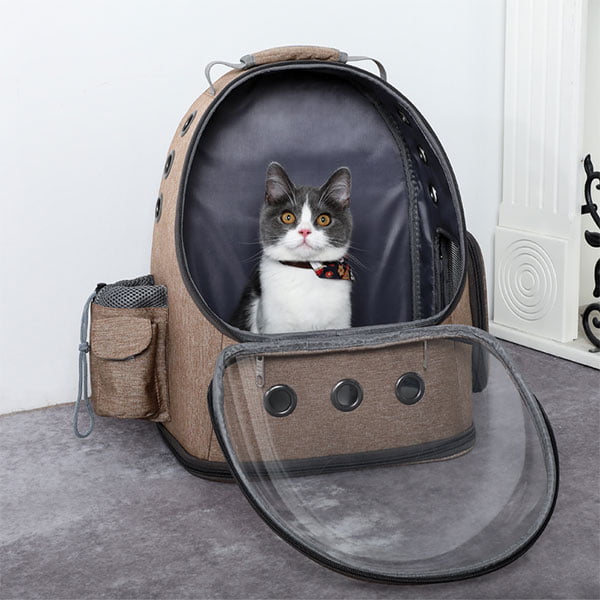
In our production experience, the most telling qualification signal comes not from certifications displayed in email signatures, but from how suppliers respond when you ask why certain popular designs fail. When a potential manufacturer can explain why a viral soft-sided carrier’s ventilation hole placement creates stress concentration that leads to mesh tearing within two months, or why a bestselling hard-shell design’s door latch mechanism has a specific failure mode under repeated use—that technical specificity indicates real manufacturing knowledge.
Production Capability Verification Beyond Stated MOQ
Many buyers treat MOQ (minimum order quantity) as the primary qualification metric, assuming higher capacity equals better reliability. That’s backwards. MOQ tells you about a factory’s order structure and business model—it doesn’t verify whether they understand pet carrier structural requirements.
Key verification questions that reveal actual production experience:
-
Ask about structural failure modes for specific designs. Request the supplier to explain common stress points in soft-sided vs. hard-shell carriers, what reinforcement methods they use at mesh-to-frame attachment points, and why certain handle attachment techniques fail. Trading companies recite specs; manufacturers discuss load distribution engineering.
-
Request material durability trade-off discussions. If you’re comparing Oxford fabric specifications, a legitimate manufacturer will explain the relationship between denier rating2, coating type, abrasion resistance, and cost—not just quote you three price tiers. We’ve seen clients specify 400D Oxford to save costs, then discover the material doesn’t withstand the friction from car seat anchoring systems.
-
Inquire about compliance testing procedures. Don’t ask "are you certified?"—ask "what specific tests do you run before declaring a carrier airline-compliant?" Experienced suppliers will reference ventilation area calculations, structural load testing methods, and specific IATA regulation clauses they verify against.
-
Discuss production lead time reasoning. If a supplier offers 15-day turnaround for a custom design with no prototype phase, that’s a red flag. Legitimate manufacturing timelines account for material sourcing, pattern adjustment, sample validation, and production line setup.
The Compliance Documentation Gap
I’ve reviewed dozens of "airline-approved" pet carrier designs where the supplier provided a certificate—but when clients actually contacted airlines for boarding approval, they discovered the certification didn’t cover the specific size/model or tested different structural features than the production version.
Here’s what buyers miss: IATA compliance for pet carriers involves specific structural requirements (ventilation area calculations, door security mechanisms, material non-toxicity) that require actual testing, not just design similarity to approved models. A supplier who can’t provide test reports showing their specific product passed ventilation sufficiency tests, structural load testing, and material safety screening likely doesn’t have legitimate compliance verification.
What to request during compliance verification:
| Document Type | What It Should Contain | Red Flags |
|---|---|---|
| IATA Compliance Report | Specific model number, ventilation area measurements, load test results | Generic certificates without model details, certificates that don’t match your ordered specifications |
| Material Safety Documentation | Test reports for fabrics/plastics showing non-toxic certification, flame resistance ratings | Supplier can’t explain which materials were tested, vague "eco-friendly" claims without standards referenced |
| Structural Testing Records | Load capacity testing at stress points (handles, latches, frame joints), repeated use cycle testing | No documentation of testing methodology, supplier claims "all carriers pass" without specific data |
In one consultation, a client showed me their supplier’s "airline-approved" certificate—it covered a hard-shell carrier, but they were ordering soft-sided mesh designs. The structural requirements are completely different. When we asked the supplier to provide testing documentation for the actual product being manufactured, they admitted they didn’t have model-specific compliance verification.
Manufacturing Transparency vs. Sales Promises
The most reliable indicator of supplier credibility is how they handle limitations and trade-offs. When we discuss custom carrier projects with clients, our conversations include explanations of why certain popular features create structural weaknesses, why material cost reductions sometimes cause disproportionate quality impacts, and which design modifications require extended testing before we’re comfortable with mass production.
Warning signs during supplier evaluation:
-
Unconditional "yes" answers to all customization requests. If a supplier instantly agrees to every design modification without discussing structural implications, they either don’t understand pet carrier engineering or plan to subcontract production without quality oversight.
-
Inability to explain past production challenges. Ask suppliers to describe a custom carrier project that required design adjustments during development. Manufacturers learn through problem-solving; trading companies just relay customer requests to actual factories.
-
Vague answers about material sourcing. When discussing fabric specifications, legitimate suppliers will name specific material suppliers, explain lead time variations based on raw material availability, and discuss quality consistency between material batches.
How Do You Avoid Structural Design Failures?
The highest return rates in pet carrier orders come from structural defects that weren’t visible during sample approval—ventilation mesh tearing at stress points, handle detachment under load, door latch failures after repeated use. These failures stem from buyers focusing on aesthetic similarity to bestsellers without understanding why certain design elements work or fail.
Avoiding structural failures requires evaluating sample carriers through stress testing scenarios, verifying reinforcement methods at identified weak points, and discussing material specifications in terms of durability trade-offs rather than just cost differences. The goal is catching design flaws before committing to 1000-unit production runs.
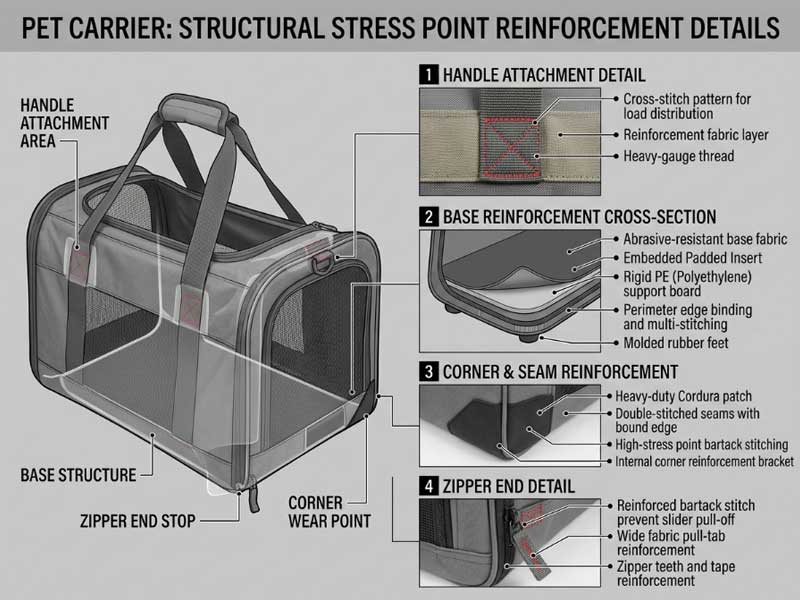
In our production experience, the three design elements that most frequently cause field failures are ventilation panel attachment methods, handle/strap anchoring systems, and door security mechanisms. Buyers who skip detailed discussions about these specific structural points during sample evaluation consistently face higher defect rates in delivered inventory.
The Ventilation Design Problem Most Buyers Miss
When evaluating pet carrier samples, buyers typically check whether ventilation holes exist—not whether the ventilation system will maintain structural integrity under stress. Here’s what we’ve observed: ventilation mesh panels create weak points in carrier structure because they replace solid fabric with breathable materials that have lower tensile strength. How those panels attach to the carrier frame determines whether they’ll tear during normal use.
Critical ventilation design questions:
-
How is the mesh secured to the frame structure? Simple hemmed edges sewn directly to fabric walls create stress concentration at corner points3. We use reinforced binding tape at mesh edges and distribute stitching across wider seam allowances to spread load.
-
What’s the mesh material specification beyond "breathable"? Nylon mesh, polyester mesh, and steel wire mesh have different abrasion resistance, UV stability, and load-bearing capacity. One client specified cheaper polyester mesh to reduce costs—it degraded under sunlight exposure during shipping, arriving with weakened panels.
-
Where are ventilation panels positioned relative to structural stress points? Placing large mesh windows directly adjacent to handle attachment zones creates competing structural demands. The frame needs rigidity for load support but flexibility for mesh panel movement.
I’ve seen viral pet carrier designs with beautiful full-panel mesh sides that look fantastic in product photos—then fail within weeks because the mesh attaches to the frame at single-point corners without load distribution reinforcement. When pets shift weight inside the carrier, those corner attachment points bear concentrated stress that exceeds the mesh’s tear resistance.
Handle and Strap Attachment Engineering
Handle detachment is the structural failure mode that generates the most dramatic customer complaints—a pet carrier suddenly dropping because the handle tore away creates safety incidents, not just inconvenience. Yet buyers rarely ask detailed questions about handle attachment methods during supplier evaluation.
What determines handle attachment reliability:
The weakest link in handle systems isn’t usually the handle material itself—it’s the attachment interface between handle and carrier body. We reinforce handle attachment points with:
- Multi-layer fabric reinforcement patches that distribute load across larger surface area rather than concentrating stress on direct stitching points
- Box-and-X stitching patterns4 that create redundant load paths—if one stitch line begins to fail, others continue supporting weight
- Material compatibility matching between handle webbing and carrier fabric to ensure similar elongation characteristics under load (mixing stiff webbing with flexible fabric creates shearing forces at the interface)
One brand reported back that their previous supplier’s carriers had handle failures at a 12% rate within the first three months of customer use. When we examined the failed samples, the issue was immediately visible: the handles were sewn directly to thin fabric without reinforcement backing, using single-line straight stitching. The attachment points simply couldn’t handle the dynamic loads from pets moving inside the carrier during transport5.
Door Mechanism Durability Testing
Door latches and zippers represent the carrier components that undergo the most repeated stress cycles—customers open and close carrier doors multiple times daily. Yet these components rarely receive appropriate durability specification during custom manufacturing discussions.
Testing approaches that reveal door mechanism weaknesses:
Before approving any custom carrier design for mass production, we run cycle testing on door mechanisms—repeatedly opening and closing latches/zippers to simulate extended use. Specific failure modes to test for:
- Zipper teeth separation under tension when pets push against closed doors
- Latch spring fatigue causing reduced closure force after repeated use cycles
- Screw attachment loosening in hard-shell carrier door hinges
- Fabric tearing around zipper tape where repeated stress concentrates
When suppliers can’t discuss their door mechanism testing protocols or claim "we use standard hardware," that’s concerning. Standard hardware isn’t optimized for pet carrier stress patterns—animals push, scratch, and apply uneven pressure that differs from typical luggage use cases.
What Compliance Standards Actually Matter for Pet Carriers?
The phrase "airline-approved pet carrier" appears in countless product listings, but what specific standards does that claim reference? In our experience consulting with brands preparing for retail distribution, the compliance gap between supplier claims and actual certification requirements causes more shipment delays and sales channel rejections than any other single issue.
Legitimate pet carrier compliance involves verifiable testing against specific standards for airline transport (IATA regulations), material safety (non-toxic certification for plastics/fabrics), and structural integrity (load-bearing capacity testing). Understanding what each certification actually verifies—and what it doesn’t—prevents compliance-based sales blocks.
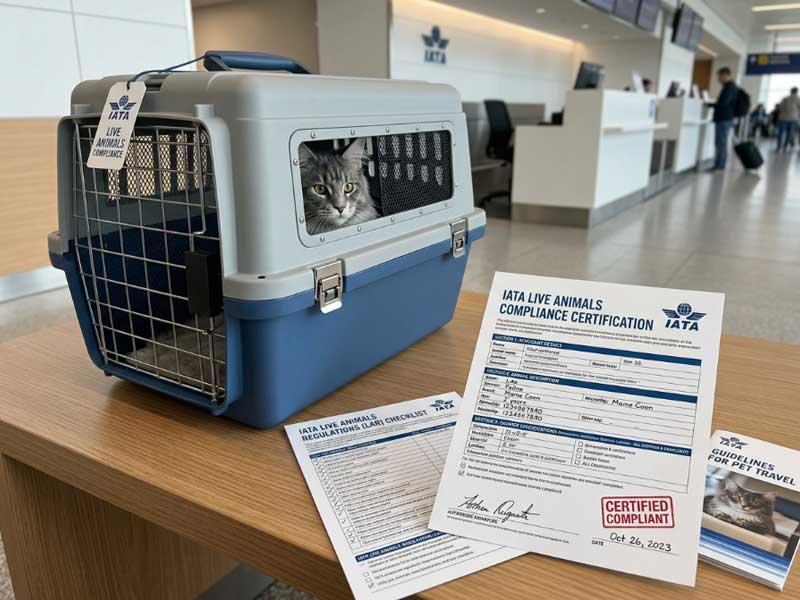
The core problem is that "compliant" carries different meanings depending on distribution channel. What satisfies Amazon’s listing requirements differs from what airline boarding staff verify at check-in, which differs from what retail chains require in supplier qualification packages. Buyers need to identify their specific compliance requirements before manufacturing begins, not discover gaps during channel onboarding.
IATA Airline Transport Standards Decoded
When suppliers claim their pet carriers meet "airline standards," they should be referencing IATA (International Air Transport Association) Live Animals Regulations6. Based on published requirements, these regulations specify dimensional limits, ventilation area calculations, structural strength requirements, and design features for pet containers approved for air transport.
Key IATA requirements buyers should verify:
- Ventilation area sufficiency: At minimum 16% of total perimeter wall space must provide ventilation7, with openings above the midline to ensure airflow even when other cargo blocks lower portions
- Structural load capacity: Container roof must support weight equivalent to 2.5 times the expected animal load8 without collapsing (actual test protocol matters here)
- Door security mechanisms: Primary door must prevent accidental opening through positive locking devices—spring latches alone don’t meet requirements
- Protrusion restrictions: No internal protrusions that could injure animals during flight turbulence
When a supplier provides IATA compliance certification, request the specific test report showing their model passed these requirements. We’ve encountered situations where suppliers presented generic certificates not tied to the exact product being ordered, or certificates covering different size categories than the buyer specified.
Material Safety Documentation Requirements
Pet carriers use plastics, treated fabrics, and sometimes foam padding materials that come into direct contact with animals. For retail distribution, especially in markets with strict consumer product safety regulations, material non-toxicity documentation becomes mandatory.
Common material safety standards relevant to pet products:
| Standard | What It Covers | When It Matters |
|---|---|---|
| REACH (EU)9 | Restricts harmful chemical substances in materials, particularly plasticizers and heavy metals | Required for European market distribution |
| California Prop 6510 | Disclosure requirements for materials containing listed chemicals | US retail sales, especially California-based retailers |
| CPSIA (if marketed to children) | Lead content limits, phthalate restrictions | Only relevant if carrier could be considered children’s product |
| EN 71 toy safety | Material safety for products children might contact | Pet carriers sold near toy sections sometimes face this requirement |
One client learned about material compliance requirements only after their retail partner’s compliance audit flagged their carrier’s plastic components for lacking proper documentation. The supplier couldn’t provide material safety test reports because they hadn’t actually conducted required screening—they assumed visual appearance meant safety compliance.
Load Testing and Structural Integrity Verification
Beyond airline-specific standards, structural integrity testing verifies that carriers can handle expected stress without catastrophic failure. This matters most for hard-shell carriers and for any design claiming heavy-duty load capacity.
Testing protocols that validate structural claims:
During production development, we conduct load testing at identified stress points:
- Handle attachment pull tests: Applying sustained and dynamic loads to handles while monitoring attachment point integrity
- Frame compression tests: For hard-shell designs, applying overhead pressure to verify roof doesn’t collapse under stacking weight
- Door security verification: Attempting forced opening of locked doors to confirm latch mechanisms won’t fail under internal pressure
- Repeated use cycling: Opening/closing doors, loading/unloading weights through openings 500+ times to identify fatigue failure modes
Suppliers who can discuss their testing methodology, show testing equipment in factory tours, and provide historical failure rate data demonstrate production maturity. Those who respond to testing questions with vague "quality control" assurances may not have formal verification processes.
How Do Material Choices Impact Carrier Quality and Cost?
Every custom pet carrier manufacturing discussion eventually reaches the material specification phase—buyers ask for fabric recommendations, suppliers present three price tiers, and decisions get made based on unit cost differences. What’s missing from these conversations is the relationship between material properties and real-world performance outcomes.
Material selection for pet carriers involves balancing durability requirements, weight considerations, cleaning maintenance, and cost constraints. The "best" material depends on intended use case, but certain material choices create predictable performance problems that buyers should understand before finalizing specifications.
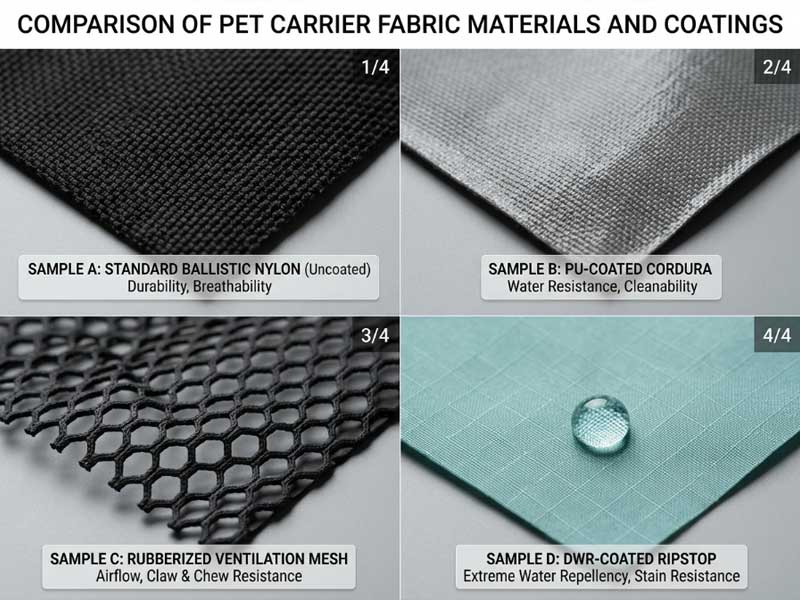
In our production experience, the material decisions that most frequently lead to quality issues are: choosing fabric based solely on denier rating without considering coating type, selecting lowest-cost plastic hardware without discussing repeated-use durability, and specifying material grades that don’t match structural stress requirements at specific carrier components.
Fabric Specifications Beyond Denier Rating
When buyers discuss fabric for soft-sided pet carriers, the conversation typically centers on denier—the fiber thickness measurement expressed as grams per 9000 meters. "600D Oxford fabric" sounds more durable than "300D," so buyers assume higher denier equals better quality. That’s oversimplified.
What actually determines fabric durability for pet carriers:
-
Coating type and application: Polyurethane (PU) coating provides water resistance and fabric stiffness11, but durability depends on coating thickness and adhesion quality. Cheaper PU coatings delaminate after repeated stress cycles or UV exposure.
-
Weave density: Two fabrics with identical denier ratings can have different thread counts, affecting tear resistance and surface smoothness. Looser weaves might cost less but create snag risks when pets’ claws contact fabric.
-
Base fiber material: Polyester fabrics offer better UV resistance than nylon12 but they generally exhibit lower ultimate tensile strength and abrasion resistance under identical denier ratings. Nylon provides superior elasticity and tear strength under high dynamic loads, making it ideal for heavy-duty structural frames, though it requires specialized UV-stabilized coatings to prevent long-term degradation.
-
Abrasion & Scratch Resistance: Standard Oxford weaves can suffer thread pulls when exposed to cat claws or abrasive ground surfaces. Utilizing high-density PVC-backed or TPE-laminated composite fabrics significantly reduces claw-snag risks while maintaining internal liquid-proof security.
Technical Summary: Practical Supplier Evaluation Matrix
To streamline your supplier vetting process, avoid relying solely on initial price quotes or glossy digital catalogs. Evaluate prospective OEM/ODM partners using this objective technical capability matrix before placing production deposits:
| Assessment Category | What to Request | Verification Target | Red Flag Signals |
|---|---|---|---|
| Structural Integrity | Sample stress test report & seam reinforcement details | Box-X stitching, continuous webbing wrap, bar-tacked handles | Single-line straight stitching on unreinforced single-layer fabric |
| Ventilation Safety | Frame attachment blueprint & mesh tear-strength specs | Reinforced binding tape around full mesh perimeter | Mesh sewn directly into outer panel seams without load distribution |
| IATA Compliance | Model-specific test report & calculation sheet | Ventilation area $\ge 16\%$ of perimeter wall; positive-locking doors | Generic "airline-approved" certificates without matching model numbers |
| Chemical Safety | Material Safety Data Sheet (MSDS) & REACH/Prop 65 reports | Pass reports for non-toxic plasticizers, heavy metals, and dyes | Vague "eco-friendly" verbal guarantees without third-party lab documentation |
Final Recommendation for B2B Buyers
Navigating custom pet carrier manufacturing requires treating the product not as a simple soft handbag, but as a functional safety structure. The cost savings achieved by selecting a supplier based solely on the lowest initial quote are routinely wiped out by a single batch of customer returns, Amazon listing suspensions, or brand reputational damage.
When evaluating your next manufacturing partner:
- Focus on failure modes: Ask suppliers how they prevent specific structural failures before discussing unit costs.
- Audit compliance depth: Verify that test reports match the precise product specifications, dimensions, and materials you plan to ship.
- Prioritize engineering transparency: Select partners who actively highlight design trade-offs, material limitations, and necessary reinforcement protocols over those who offer unconditional promises.
By aligning with an OEM partner that emphasizes structural engineering over aggressive cost-cutting, you protect your brand’s profitability, lower return rates, and deliver a safe product for end users.
-
"Analysis of the Influencing Factors and Consequences of E …", https://www.researchgate.net/publication/387443798_Analysis_of_the_Influencing_Factors_and_Consequences_of_E-commerce_Return_Rate. Research on e-commerce economics indicates that product return rates above certain thresholds can eliminate profit margins due to reverse logistics costs, inventory loss, and refund processing, with return rates varying significantly by product category and quality levels. Evidence role: general_support; source type: research. Supports: High product return rates can eliminate profit margins in consumer goods manufacturing and e-commerce. Scope note: The citation supports the general economic principle that high returns impact profitability but does not provide pet carrier-specific data or exact return rate thresholds. ↩
-
"Units of textile measurement – Wikipedia", https://en.wikipedia.org/wiki/Units_of_textile_measurement. In textile manufacturing, denier is a unit of measurement for linear mass density of fibers, defined as the mass in grams per 9,000 meters of fiber length, commonly used to specify the thickness and weight characteristics of yarns and fabrics. Evidence role: definition; source type: encyclopedia. Supports: Denier is the standard textile industry unit for measuring fiber thickness. ↩
-
"Stress concentration – Wikipedia", https://en.wikipedia.org/wiki/Stress_concentration. In structural mechanics, stress concentration refers to the amplification of stress that occurs at geometric discontinuities such as corners, holes, or material transitions, where applied loads become concentrated in smaller areas rather than distributed evenly across the structure. Evidence role: mechanism; source type: education. Supports: Stress concentration occurs at geometric discontinuities where applied loads focus on smaller areas. Scope note: The citation explains the general engineering principle of stress concentration but does not specifically address textile applications or pet carrier design. ↩
-
"How to Properly Sew a Box X Stitch – Sailrite", https://www.sailrite.com/How-to-Sew-a-Box-X-Stitch?srsltid=AfmBOorqkUpebIK6BNRWAHONOrVSk_WSvNsKQkAQegw04Sb3-0ZivWe9. In textile engineering, box-and-X stitch patterns (also called bartack stitching) distribute mechanical loads across multiple thread paths, creating redundancy so that if individual stitches fail under stress, other stitch lines continue to bear the load and maintain structural integrity. Evidence role: mechanism; source type: education. Supports: Box-and-X stitching patterns provide redundant load distribution in textile attachment points. Scope note: The citation supports the mechanical principle of redundant load paths in stitching but may not cite specific testing data for pet carrier applications. ↩
-
"The Dynamic Behavior of Liquids in Moving Containers …", https://ntrs.nasa.gov/citations/19670006555. In structural engineering, dynamic loads generated by moving masses produce greater stresses and different force distributions than static loads of equivalent weight, because movement introduces acceleration forces, impact factors, and time-varying stress patterns that structures must withstand. Evidence role: mechanism; source type: education. Supports: Dynamic loads from moving masses create greater structural stress than equivalent static loads. Scope note: The citation explains general dynamic loading principles but does not specifically address animal movement patterns or pet carrier structural requirements. ↩
-
"Traveler’s Pet Corner", https://www.iata.org/en/programs/cargo/live-animals/pets/. The International Air Transport Association publishes the Live Animals Regulations (LAR), which establish technical specifications for animal transport containers used in air cargo, including ventilation area requirements, structural load capacity, and security mechanisms. Evidence role: general_support; source type: institution. Supports: IATA publishes Live Animals Regulations containing specific requirements for pet transport containers including ventilation, structural, and dimensional standards. Scope note: The citation confirms the existence and general scope of IATA LAR but does not verify each specific technical requirement mentioned in the article. ↩
-
"Traveler’s Pet Corner", https://www.iata.org/en/programs/cargo/live-animals/pets/. IATA’s Live Animals Regulations specify minimum ventilation requirements for animal containers, calculated as a percentage of total perimeter wall space to ensure adequate airflow during transport. Evidence role: statistic; source type: institution. Supports: IATA LAR specifies the minimum ventilation area percentage required for pet transport containers. Scope note: The citation supports that IATA establishes ventilation area percentages but requires verification of the exact 16% figure from current IATA LAR editions. ↩
-
"Traveler’s Pet Corner – IATA", https://www.iata.org/en/programs/cargo/live-animals/pets/. IATA Live Animals Regulations specify that animal container roofs must withstand overhead loads calculated as multiples of the anticipated animal weight to prevent collapse during stacking and transport. Evidence role: statistic; source type: institution. Supports: IATA LAR establishes structural load capacity requirements for animal container roofs expressed as multiples of expected animal weight. Scope note: The citation confirms IATA establishes load-bearing standards but requires verification of the specific 2.5× multiplier from current regulations. ↩
-
"Registration, Evaluation, Authorisation and Restriction of Chemicals", https://en.wikipedia.org/wiki/Registration,_Evaluation,_Authorisation_and_Restriction_of_Chemicals. The European Union’s REACH regulation (Registration, Evaluation, Authorisation and Restriction of Chemicals) establishes controls on chemical substances in products sold in EU markets, including restrictions on plasticizers, heavy metals, and other potentially harmful compounds. Evidence role: definition; source type: government. Supports: REACH is the European Union regulation governing chemical substance restrictions in manufactured products. ↩
-
"Proposition 65", https://oehha.ca.gov/proposition-65. California’s Proposition 65 (Safe Drinking Water and Toxic Enforcement Act of 1986) requires businesses to provide warnings about significant exposures to chemicals that California identifies as causing cancer, birth defects, or reproductive harm. Evidence role: definition; source type: government. Supports: California Proposition 65 establishes chemical disclosure requirements for products sold in California. ↩
-
"Development of Breathable Waterproof Polyurethane-Coated …", https://pmc.ncbi.nlm.nih.gov/articles/PMC12509000/. In textile science, polyurethane coatings applied to fabrics create a polymeric barrier that provides water resistance by preventing liquid penetration, while also increasing fabric stiffness and modifying mechanical properties through the addition of a solid polymer layer to the textile substrate. Evidence role: mechanism; source type: research. Supports: Polyurethane coatings modify fabric properties including water resistance and mechanical stiffness. ↩
-
"A comprehensive review of ultraviolet radiation and functionally modified …", https://pmc.ncbi.nlm.nih.gov/articles/PMC11605348/. Textile research indicates that synthetic fibers exhibit different susceptibilities to ultraviolet degradation, with polyester generally showing superior UV stability compared to nylon due to differences in polymer structure and how UV radiation initiates photo-oxidative degradation in each material. Evidence role: general_support; source type: research. Supports: Polyester and nylon fibers have different UV degradation characteristics. Scope note: The citation confirms different UV resistance between these fiber types but the degree of difference can vary based on specific polymer formulations, additives, and fabric treatments. ↩