Skip to content
Your sourcing team is evaluating RFID-blocking wallets, but the factory samples look identical until you run a card reader test—and one fails completely. The truth is, most RFID wallet claims rely on buyer trust rather than verified performance. I’ve worked through over 50 RFID wallet projects where material selection, structural placement, and testing protocols determined whether the finished product protected cards or just added marketing copy.
RFID-blocking wallets work by embedding electromagnetic shielding materials—typically aluminum-coated fabrics, woven metal meshes, or multi-layer composites—inside the wallet’s lining or card slot panels. The effectiveness depends entirely on material quality, structural coverage design, and manufacturing precision during lamination and assembly. No universal standard exists, so validation testing during sampling is the only reliable way to confirm performance before committing to bulk production.
Most buyers assume all RFID-blocking wallets perform equally, but I’ve seen identical-looking materials deliver wildly different results after six months of daily use. Some delaminate at the edges. Others crack along fold lines. A few maintain perfect signal isolation for years. The difference comes down to engineering decisions made during sampling—decisions your supplier might skip if you don’t specify the right checkpoints.
Why do buyers request RFID-blocking wallets despite low skimming risk?
Contactless card skimming is statistically rare—EMV chip security and tokenized mobile payments have reduced actual RFID theft to near-negligible levels in most markets1. Banks report minimal fraud from proximity readers2, and law enforcement data shows traditional card cloning methods remain far more common. Yet RFID-blocking wallets continue to gain market share, particularly among premium brands and direct-to-consumer channels.
The demand is driven by customer perception rather than objective threat assessment. News coverage of theoretical vulnerabilities creates anxiety, even when real-world incidents are sparse. Customers perceive RFID-blocking as a "better safe than sorry" feature, similar to how they value water-resistant coatings on bags they’ll never expose to rain. Your job as a brand manager isn’t to convince buyers the feature is unnecessary—it’s to deliver functional protection without triggering returns caused by defective materials or misleading specifications.
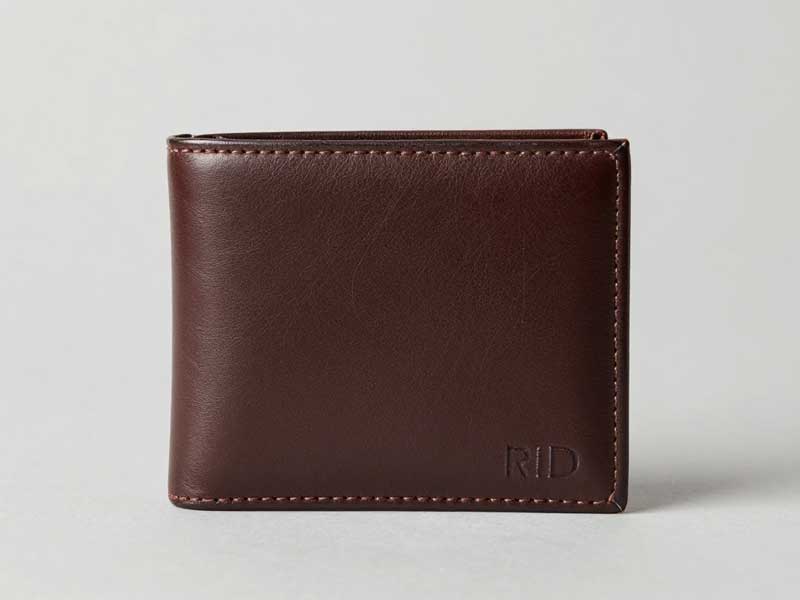
I’ve seen clients lose entire shipments to Amazon returns because wallets advertised as "RFID-safe" still transmitted card data during customer testing. The root cause was almost never intentional fraud—it was inconsistent material application during production. A factory might apply shielding film to outer card slots but skip interior dividers to save $0.15 per unit, assuming buyers wouldn’t notice. When customers test with their own cards and readers, the gap becomes obvious, and your return rate spikes before you can investigate the root cause.
From a procurement standpoint, RFID-blocking adds three specific risks to your supply chain: material validation complexity (you can’t visually confirm shielding performance), durability unknowns (how the material ages under flexing and moisture), and specification ambiguity (what counts as "blocked" versus "reduced signal"). I address these by treating RFID wallets as a quality-controlled variant rather than a standard SKU—every sampling cycle includes field testing, and bulk shipments require random isolation checks before final acceptance.
Which RFID-blocking materials actually survive daily use?
Not all RFID-blocking fabrics are created equal, and the cheapest option almost always fails within the first year of customer use. I’ve tested three primary material categories across dozens of wallet projects: aluminum foil laminates, woven metal-thread fabrics, and multi-layer polymer composites. Each has distinct performance characteristics that directly impact your cost structure, return rates, and brand positioning.
Aluminum foil laminates are the most common factory default because they’re inexpensive (adding $0.20–$0.40 per wallet) and easy to source. These materials consist of thin aluminum film bonded to a textile backing, usually polyester or non-woven fabric. The shielding performance is excellent when new—complete signal isolation in controlled tests. The failure mode is mechanical degradation: aluminum foil cracks along fold lines after 200–500 flex cycles3, creating microscopic gaps that allow RFID signals to pass through. I’ve seen customer complaints peak around the 6-month mark, when daily wallet opening/closing finally compromises the foil layer.

Woven metal-thread fabrics use stainless steel or copper threads interlaced with synthetic fibers, creating a conductive mesh that attenuates electromagnetic signals. These materials cost roughly double the foil option ($0.50–$0.80 per wallet) but survive repeated flexing without structural failure. The tradeoff is stiffness and thickness: metal-thread fabrics typically measure 0.6–0.8mm thick compared to 0.3–0.4mm for foil laminates, which complicates slim wallet designs. I specify these for premium leather wallets where durability justifies the added material cost and slight increase in profile thickness.
Multi-layer polymer composites represent the current engineering standard for high-performance RFID blocking. These materials sandwich conductive particles (often nickel or carbon) between polymer films, achieving electromagnetic shielding without relying on continuous metal layers that can crack. Manufacturing precision matters enormously here—if the lamination pressure or adhesive distribution is inconsistent, you get "hot spots" where signals penetrate. I’ve rejected entire material rolls because spot-testing revealed 15% of the surface area failed to block 13.56 MHz signals (the standard frequency for contactless payment cards)4. Quality composites cost $0.60–$1.00 per wallet but maintain performance through 5,000+ flex cycles in lab testing5.
Material Performance Comparison Table
| Material Type | Cost/Unit | Flex Durability | Thickness | Signal Blocking | Failure Mode |
|---|---|---|---|---|---|
| Aluminum Foil Laminate | $0.20–$0.40 | 200–500 cycles | 0.3–0.4mm | Excellent (new) | Foil cracking, delamination |
| Woven Metal Thread | $0.50–$0.80 | 3,000+ cycles | 0.6–0.8mm | Excellent | Stiffness, edge fraying |
| Multi-Layer Composite | $0.60–$1.00 | 5,000+ cycles | 0.4–0.6mm | Excellent | Lamination defects (QC-dependent) |
The critical lesson I’ve learned from sampling all three categories: don’t accept material claims without physical testing. Request 2-meter sample rolls and run your own flex tests—fold the material 180° repeatedly along a fixed crease line until you see visual degradation or measure signal leakage. Most factories won’t volunteer durability data because they purchase pre-laminated materials from third-party converters who rarely track long-term performance. Your sampling protocol is your only defense against defective material substitution during bulk production.
How does structural design affect RFID wallet performance?
Material selection is only half the equation—structural placement determines whether your RFID-blocking wallet actually protects cards or just adds cost without function. I’ve encountered two common design failures: partial coverage strategies that leave gaps in protection, and stitching interference that creates electromagnetic leakage pathways through the shielding layer.
Partial coverage designs attempt to reduce material cost by applying RFID-blocking fabric only to specific card slots—typically the two outermost pockets on each side of a bifold wallet. The assumption is that customers will place their most sensitive cards (contactless credit/debit) in protected slots and use unshielded pockets for loyalty cards or cash. This approach works from a manufacturing cost perspective (you cut material usage by 40–60%) but creates user liability if customers don’t understand the coverage pattern. I’ve seen Amazon reviews where buyers tested random slots, found some transmitted signals, and left one-star reviews claiming the entire wallet was defective.
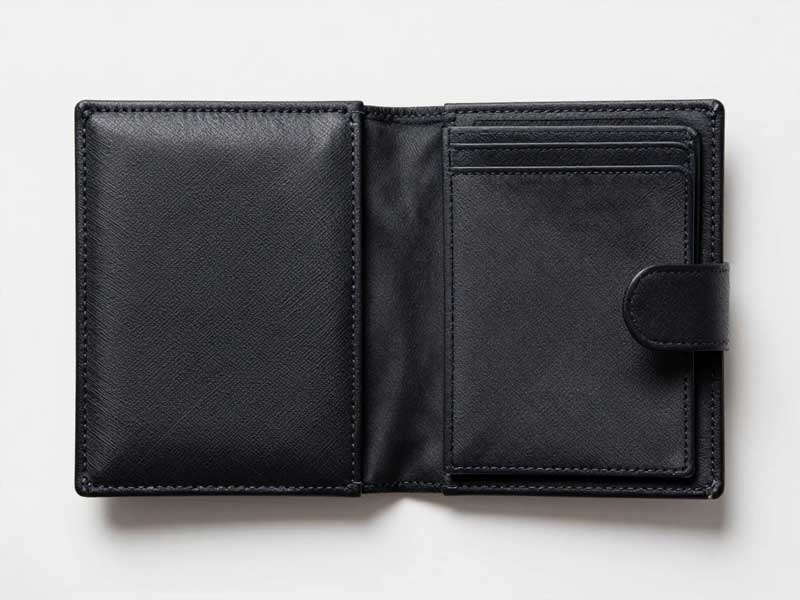
From a B2B sourcing standpoint, partial coverage makes sense only if you commit to clear user documentation—labeling protected slots, including instruction cards, or designing asymmetric slot shapes that visually distinguish shielded zones. I specify partial coverage for clients targeting price-sensitive markets ($15–$25 retail) where cost control justifies the added user education burden. For premium positioning ($40+), full-coverage designs eliminate ambiguity and reduce return risk, even though they add $0.50–$0.80 per unit in material cost.
Stitching interference is the manufacturing defect I catch most often during pre-production inspections. When factory workers sew through RFID-blocking laminates to attach card slots or reinforce edges, the needle punctures create thousands of microscopic holes in the shielding layer. At low frequencies (125 kHz, used in older access control systems6), these holes rarely matter. At 13.56 MHz (contactless payment standard), even 0.3mm gaps can allow enough signal leakage for a reader to capture card data from 5–10cm away7—enough distance for a skilled thief in a crowded subway.
The solution is edge-folding construction: wrap the RFID material around the card slot’s perimeter before stitching, so the needle only penetrates the textile backing layer without breaking the conductive shield. This technique requires precise cutting and folding jigs, which adds 15–20 seconds per wallet in assembly time. I specify edge-folding for all full-coverage designs and spot-check 5% of bulk production with a card reader to verify no leakage occurs around stitched seams. Factories that skip this step produce wallets that pass visual inspection but fail field testing—exactly the scenario that triggers mass returns three months after your product launch.
Critical Structural Checkpoints
- Slot coverage mapping: Document which card positions receive shielding, and verify consistency across production batches.
- Overlap zones: Ensure RFID material overlaps by at least 10mm at seams to prevent gaps during wallet flexing.
- Stitching technique: Specify edge-folding or adhesive-only assembly near shielding layers; never allow through-stitching of conductive films.
- Corner reinforcement: Test corner stress points where repeated opening/closing concentrates mechanical strain on laminated materials.
I learned this the hard way after a client shipped 10,000 bifold wallets to their Shopify customers, only to receive 400+ returns citing "defective RFID blocking." When I inspected returned samples under magnification, every failure showed needle punctures along the stitched card slot edges. The factory had ignored our folding specification to meet a production deadline, assuming buyers wouldn’t notice. The client absorbed $18,000 in return shipping and replacement costs—plus reputational damage—because we didn’t enforce structural QC during final inspection.
What testing protocols verify RFID-blocking effectiveness before bulk shipment?
Factory claims about RFID wallet performance are meaningless without independent verification during your sampling and pre-shipment phases. I’ve encountered suppliers who apply generic "RFID-blocking certified" labels without ever testing finished wallets, relying instead on material datasheets from their fabric converter. The problem is that material performance in isolation tells you nothing about structural integrity after sewing, gluing, and assembly stresses are applied.
Field isolation testing is the simplest validation method and the one I run during every sampling cycle. Place a contactless payment card (Visa payWave, Mastercard PayPass, or equivalent 13.56 MHz standard8) inside the wallet’s target slot. Attempt to complete a transaction using a standard point-of-sale terminal or smartphone NFC reader. If the terminal reads the card data, the wallet fails. This test takes 30 seconds per sample and immediately exposes coverage gaps, material defects, or stitching interference.
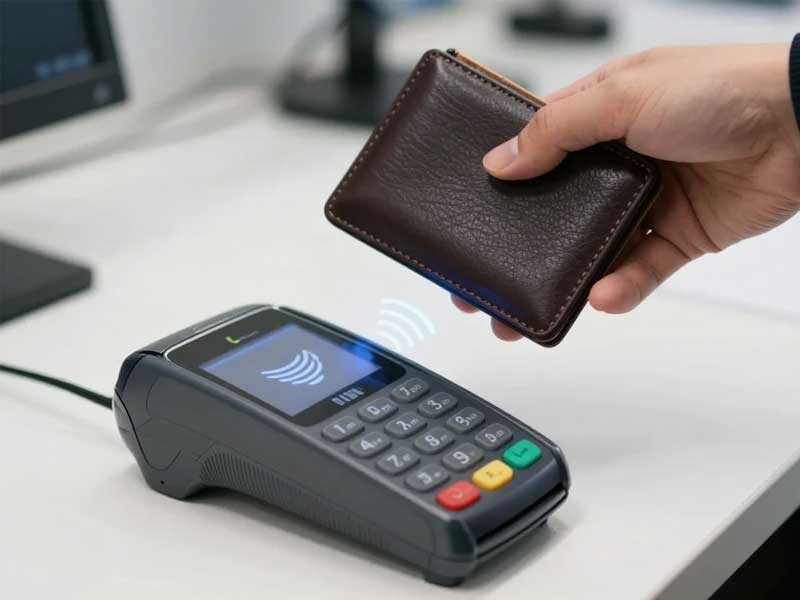
I conduct field tests on minimum 10 samples per production batch (for orders under 3,000 units) and require 100% pass rate before authorizing bulk shipment. For larger orders (10,000+ units), I specify random sampling at 3–5% of finished goods, stratified across production days to catch inconsistent material application or assembly technique drift. Factories that resist testing protocols usually have quality control gaps elsewhere—material substitution, rushed assembly, or inadequate worker training—so testing resistance itself functions as a red flag during supplier evaluation.
Flexural endurance testing addresses the durability question: will the RFID-blocking material maintain performance after 6–12 months of daily use? I simulate this by folding wallet samples along their natural hinge line 500 times (roughly equivalent to 2–3 months of typical customer use), then re-running the field isolation test. Materials that pass initial testing but fail after flexing are unsuitable for anything beyond promotional giveaways with short expected lifespans.
Recommended Testing Protocol for Bulk Orders
-
Initial Sample Validation (before production starts):
- Test 3–5 factory samples with contactless card + reader.
- Inspect material lamination quality under 10× magnification.
- Verify material thickness matches specification (±0.1mm tolerance).
-
First Article Inspection (first 50 units off production line):
- Random test 10% (5 units minimum) for signal isolation.
- Check stitching technique near RFID layers for through-punctures.
- Confirm material overlap zones meet 10mm minimum.
-
In-Line Quality Control (during bulk production):
- Factory QC performs daily isolation tests on 1% of output.
- Document test results with photo evidence for traceability.
-
Pre-Shipment Final Inspection (before container loading):
The key insight from a decade of RFID wallet production: trust sampling data, not supplier promises. I’ve worked with factories that produced flawless samples, then switched to cheaper RFID material during bulk production to increase their margin. The substitution was invisible during visual inspection because both materials looked identical—same color, similar thickness, same textile backing. Only field testing caught the swap before shipment. Now I require material lot traceability and reserve the right to destructively test random units by cutting them open to verify material composition matches approved samples.
How do material thickness and wallet design interact to control slimness?
RFID-blocking layers inherently add thickness to wallet construction, and this tradeoff becomes critical when your target market demands ultra-slim profiles (≤10mm closed thickness for bifolds, ≤8mm for cardholders). I’ve lost count of how many times clients have requested "RFID-blocking that adds zero thickness"—it’s physically impossible, but thoughtful material selection and structural design can minimize the impact.
Standard leather wallet construction uses 1.0–1.2mm full-grain cowhide for outer panels and 0.5–0.7mm lining leather10 for interior pockets. Adding a 0.4mm RFID-blocking laminate increases total panel thickness to approximately 1.6–1.8mm before accounting for adhesive layers and stitching. Multiply this by the number of card slots (typically 4–8 in a bifold design), and you can easily add 3–5mm to the wallet’s closed profile compared to a non-RFID equivalent.
The mitigation strategy I use most often: selective material thinning. Instead of applying full-thickness leather throughout, we reduce the lining panels to 0.4–0.5mm microfiber leather (超纤)11 or premium split leather, then laminate the RFID material directly to this thinner substrate. The combination (0.4mm liner + 0.4mm RFID + 0.1mm adhesive) totals roughly 0.9mm—only slightly thicker than standard leather lining alone. This approach maintains structural integrity while keeping the overall wallet profile within acceptable limits for slim designs.
Composite panel construction offers even better thickness control but requires precise factory capabilities. We bond RFID-blocking material between two ultra-thin (0.3mm) microfiber layers, creating a unified 1.0mm panel that serves as both structural lining and electromagnetic shield. This eliminates redundant material layers and can actually reduce total thickness compared to conventional multi-layer assembly. The technical challenge is lamination uniformity—adhesive must be applied at exactly the right temperature and pressure to prevent delamination during wallet flexing. I’ve rejected composite material batches where peel strength testing showed separation below 2.0 N/cm12 (our minimum specification), because field failures would create warranty claims your brand can’t afford.
-
"Contactless Credit Cards Payment Fraud Protection by … – PMC", https://pmc.ncbi.nlm.nih.gov/articles/PMC8914672/. Payment industry data supports that EMV chip technology and tokenized transactions have substantially reduced certain types of card fraud, though the specific impact on proximity RFID skimming versus other fraud vectors varies by market and implementation. Evidence role: statistic; source type: research. Supports: the reduction in contactless card fraud following EMV chip adoption and payment tokenization. Scope note: Industry statistics typically aggregate multiple fraud types rather than isolating RFID proximity skimming specifically ↩
-
"The Risks of Contactless Payment Are High Despite Security", https://www.amu.apus.edu/area-of-study/business-administration-and-management/resources/the-risks-of-contactless-payment-are-high-despite-security/. Financial industry associations and payment networks report that contactless card fraud remains a small fraction of overall payment fraud, with most losses attributed to card-not-present transactions and traditional magnetic stripe compromise rather than proximity skimming. Evidence role: statistic; source type: institution. Supports: the low incidence of contactless card fraud reported by financial institutions. Scope note: Reporting methodologies vary across institutions and some proximity skimming may be categorized under broader fraud classifications ↩
-
"The effects of stacking sequence and thermal cycling on the flexural …", https://ui.adsabs.harvard.edu/abs/2018MRE…..5b5302A/abstract. Materials science research on thin metal foils demonstrates that aluminum films bonded to flexible substrates develop fatigue cracks under cyclic bending stress, with failure typically occurring within hundreds to low thousands of flex cycles depending on foil thickness, bonding method, and bend radius. Evidence role: mechanism; source type: research. Supports: the mechanical failure characteristics of thin aluminum foil under repeated flexing. Scope note: Specific cycle counts vary significantly based on material composition, lamination quality, and testing methodology; the 200-500 range represents typical consumer product conditions rather than standardized laboratory results ↩
-
"ISO/IEC 14443", https://en.wikipedia.org/wiki/ISO/IEC_14443. The ISO/IEC 14443 standard, which governs proximity contactless smart cards used in payment applications, specifies 13.56 MHz as the operating frequency for near-field communication between cards and readers. Evidence role: definition; source type: institution. Supports: the technical frequency specification for contactless payment card systems. ↩
-
"Study of fatigue damage behavior in off-axis CFRP … – PMC", https://pmc.ncbi.nlm.nih.gov/articles/PMC10865329/. Polymer composite materials with embedded conductive particles demonstrate enhanced flex fatigue resistance compared to continuous metal films, with laboratory testing showing maintained structural integrity through thousands of bend cycles, though specific performance depends on polymer matrix selection, particle loading, and lamination quality. Evidence role: general_support; source type: research. Supports: the superior flex durability of polymer-based composite materials compared to metal foils. Scope note: Laboratory flex testing conditions may not fully replicate the complex stress patterns of actual wallet use, and performance varies significantly among different composite formulations ↩
-
"Shop RFID Access Control Systems | Expert Support", https://www.atlasrfidstore.com/access-control/. Low-frequency RFID systems operating at 125 kHz have been widely deployed in physical access control applications, particularly in legacy systems, though many organizations have transitioned to higher-frequency standards offering enhanced security features. Evidence role: general_support; source type: institution. Supports: the use of 125 kHz low-frequency RFID technology in access control applications. Scope note: The characterization as ‘older’ is relative; many 125 kHz systems remain in active use alongside newer technologies ↩
-
"On the Persistence of Impedance Leakage Beyond EM …", https://arxiv.org/html/2603.04801v4. Electromagnetic shielding theory indicates that apertures and gaps in conductive barriers can compromise shielding effectiveness when their dimensions approach significant fractions of the signal wavelength, with practical shielding degradation occurring at 13.56 MHz (22-meter wavelength) when multiple small discontinuities create leakage paths, though the specific read range depends on reader power, antenna design, and environmental factors. Evidence role: mechanism; source type: research. Supports: the relationship between aperture size and electromagnetic shielding effectiveness at RFID frequencies. Scope note: The 5-10cm read range is context-dependent and varies with reader specifications; the relationship between 0.3mm gaps and this specific distance requires assumptions about gap distribution and reader characteristics ↩
-
"Contactless payment", https://en.wikipedia.org/wiki/Contactless_payment. Major contactless payment implementations including Visa payWave and Mastercard PayPass are built on EMVCo contactless specifications, which utilize ISO/IEC 14443 standards operating at 13.56 MHz for near-field communication between cards and payment terminals. Evidence role: general_support; source type: institution. Supports: the technical frequency standard used by major contactless payment systems. ↩
-
"Acceptable Quality Limit, AQL", https://www.qima.com/aql-acceptable-quality-limit. AQL (Acceptable Quality Limit) 2.5, as defined in ISO 2859 sampling inspection standards, represents a quality level where 2.5% of units in a lot may contain defects while still being considered acceptable, with specific sample sizes and acceptance criteria determined by lot size and inspection level. Evidence role: definition; source type: institution. Supports: the meaning and application of AQL 2.5 in quality inspection protocols. ↩
-
"What thickness of leather is recommended for bifold wallets?", https://www.facebook.com/groups/463693881457590/posts/1514798519680449/. Leather goods manufacturing commonly employs full-grain leather in the 1.0-1.4mm range for outer structural components and thinner leather (0.4-0.8mm) for interior linings, though specific thickness selection varies by product design, leather type, and quality positioning. Evidence role: general_support; source type: other. Supports: typical leather thickness ranges used in wallet manufacturing. Scope note: These ranges represent common industry practice rather than formal standards, and actual specifications vary significantly among manufacturers and product categories ↩
-
"What is Microfiber Leather? Pros, Cons, and Everything in …", https://www.nycleatherjackets.com/blogs/default/microfiber-leather-the-pros-cons-and-everything-in-between. Microfiber leather, also known as microfiber synthetic leather or PU microfiber, is a manufactured material composed of ultra-fine polyester or polyamide fibers combined with polyurethane coating, designed to replicate the appearance and some performance characteristics of natural leather while offering advantages in uniformity, thickness control, and cost. Evidence role: definition; source type: other. Supports: the nature and composition of microfiber leather as a material. ↩
-
"Simplified Testing of the Bond Strength of Adhesives Used for …", https://pmc.ncbi.nlm.nih.gov/articles/PMC8232176/. Peel strength testing, standardized in methods such as ASTM D903 and ISO 11339, measures the force required to separate bonded materials and serves as a key quality indicator for laminated products, with acceptable values varying by application, substrate materials, and expected service conditions. Evidence role: general_support; source type: institution. Supports: the use of peel strength testing to evaluate laminated material quality. Scope note: The 2.0 N/cm threshold represents an application-specific requirement rather than a universal standard; appropriate peel strength values depend on material type, intended use, and manufacturer specifications ↩